Jorma Etto, “Mothers”

fog

Äidit
Siellä ne, osastolla, synnyttäneet,
petinsä pohjalla pötköttävät,
tyytyväiset tytöt,
ruusun ja maidon makeassa hajussa,
mahdottoman mellevinä,
möyheinä möykkinä, hymyhyytelöinä.
Tupakkirullat tuu tuu tuotiin,
lirulirkutus lirisi,
tussutettiin, tassutettiin, tuputettiin,
lettas-sentään, tissin-tassin,
omenaista, olevaista,
pehmokaista pullukaista paijatella,
maamotella makeaista
ilo on, on onni,
nänni nauraa, koko äiti.

Mothers
They are there, in the ward, after birthing,
cuddled deep in their cots,
contented lassies,
smelling sweetly of rose and milk,
impossibly, incomparably cozy,
super succulent blobs, smiling jellies.
The cigars were ro-ro-rolled,
there was dribbling, cooing, and gurgling,
fiddling, tiptoeing, and foisting,
dear oh dears, pitter patters.
Joy it is, a happiness
mothering a sweet thing,
snuggling a soft chubby,
an appley entity.
The nipple giggles, the whole mother.

Source: Jorma Etto, Suomalainen ja muut valitut (Oulu: Pohjoinen, 1985), p. 52. Photo and translation by Thomas H. Campbell

Jorma Etto, “Life Is”

clouds over the vuoksi

elämä on
niin suurena niin tavoittamattomana
oli elämä edessäsi
ja sinä sanoit itsellesi
ennen kuin kaiken jätät
kaiken myös ymmärrät

nyt
kun käännyt katsomaan taaksesi
kun uskallat sen tehdä
näet elämän
yhtä suurena yhtä tavoittamattomana
ja poikasi näet
seisovan hautakivesi äärellä
pitäen kädestä jotakin konttorityttöä
(hautausmaan rauhassa heilläkin
on tilaisuus olla oma itsensä)
ja kuulet poikasi kuiskaavan
hänen suloiseen pikku korvaansa
salaisuuden jota sinä et ymmärtänyt
elämä on
(niin hän kuiskaa
ja hän tietää)
elämä on

life is
life confronted you
so great so unattainable
and you said to yourself
before you left it all
you would understand it all, too

now
when you’ve turned to look back
when you dare to do it
you see life
just as great just as unattainable
and you see your son
standing before your tombstone
holding the hand of some office girl
(in the cemetery’s calm they have
a chance to be themselves)
and you hear your son whispering
into her sweet little ear
the secret you didn’t understand
life is
(so he whispers
and he knows)
life is

Source: Jorma Etto, Suomalainen ja muut vaalitut (Oulu: Pohjoinen, 1985), p. 5. Photo and translation by Thomas H. Campbell

Vilja-Tuulia Huotarinen, “Contrary to Popular Belief”

nine.JPG

Toisin kuin luullaan, useat asiat tulevat valmiiksi,
sellaisiksi kuin niiden halutaan tulevan.
Vapaudesta puhutaan kuin valinnasta,
pidetään hengitys tasaisena että ilma kantaa
höyhentä.
Voi nostaa vihreän rinkan selkään,
vähemmän se painaa kuin omat hartiat.
Saa puhua viidellä kielellä siitä mistä puhetta riittää,
eikä muutosta ole havaittavissa kun siiryymme
paikasta toiseen; kiinnitämme huomioon
samaan maisemaan, siihen jonka omin silmin näemme.

Ajojää sulaa pyörien alla ja vuoret kolahtelevat toisiinsa,
jättiläisen kyynärpäät. Ajamme peräkkäin autoilla
kuuntelemaan valaan röyhtäilyjä. Kun tuuli yltyy,
alkaa tärisyttää, silmät ja tasapainoaisti antavat eri viestin.
Mutta ei hätää:
pahoinvointiin auttaa piste
jonka rantaviivalta löydämme, se johon taas on tuijotettava.

Olemme syyttömiä,
miljoonia vuosia vanhat ruhot painuvat pinnan alle.
Niin meidät harppunoidaan
kesken lauseen, kesken haukotuksen

eikä mikään voi torjua lohtua.

* * * * * * * * *

Contrary to popular belief, many things emerge intact,
just as one would want them to turn out.
Freedom is spoken of as a choice.
One breathes steadily so the air holds
a feather aloft.
You can lift the green rucksack on your back:
it weighs less than your own shoulders.
You may speak in five languages about something when a chat would do,
nor is change observable when we move
from place to place. We fix our gaze
on the same landscape, towards what see with our own eyes.

Drift ice melts under the wheels, and mountains bump into each other,
a giant’s elbows. We drive one after another in cars
to hearken to a whale’s belches. When the wind blows harder,
it begins to shake, and the eyes and sense of balance send a different message.
Not to worry:
nausea is alleviated by a point
we locate on the shoreline, a point toward which we must stare again.

We are blameless,
carcasses, millions of years old, sinking below the surface.
We are thus harpooned
in the middle of a sentence, in the middle of a yawn

nor can anything ward off consolation.

Source: Vilja-Tuulia Huotarinen, Sakset kädessä ei saa juosta (WSOY, 2004), p. 29. Translation and photo by Thomas H. Campbell

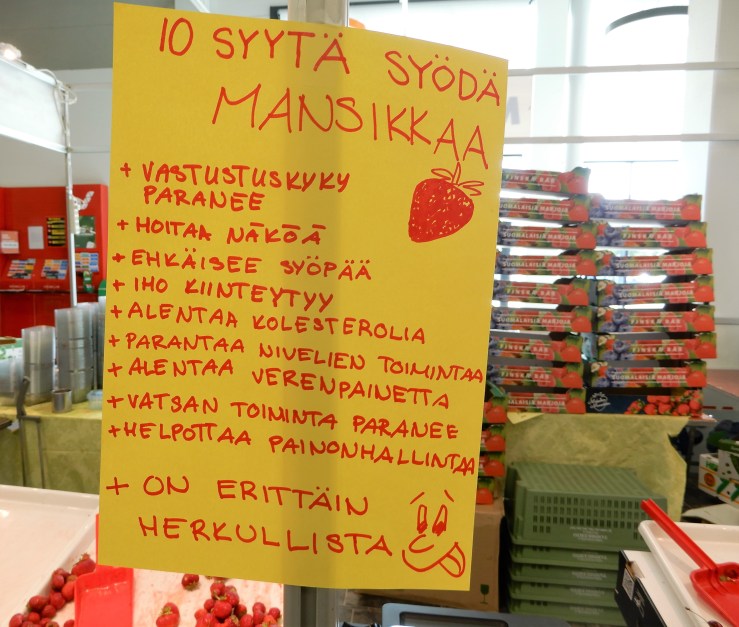
10 Reasons to Eat Strawberries

It is a tiny miracle that strawberries grow this far north. It is even more of a miracle that Finnish strawberries are supremely delicious, perfectly succulent and sweet.

Finns celebrate this miracle by eating as many strawberries as they can while they are in season.

They also honor strawberries by incorporating them into desserts concocted only on the most festive occasions, such as the strawberry whipped cream cake our downstairs neighbor Maija makes on her birthday, her name day, and her husband’s name day,  which all take place in July and August, during and just after the peak of the all-too-brief Finnish strawberry season.

Maija’s strawberry whipped cream cake is to die for, by the way.

But strawberries are not just delicious, they are good for you, too, as I was reminded yesterday by this placard at the pop-up strawberry stand at my local grocery store.

ten reasons to eat strawberries

10 Reasons to Eat Strawberries

  • It improves the immune system.
  • It maintains eyesight.
  • It prevents cancer.
  • It firms up the skin.
  • It lowers cholesterol.
  • It makes the joints work better.
  • It lowers blood pressure.
  • It improves digestion.
  • It helps control weight.
  • It is positively yummy.


Photo and translation by Living in FIN

Jorma Etto, “The Boys”

purple swirl

Pojat

Naapuri löysi unohdetun helmen, sika sen söi,
jonkun sanottiin tavanneen aarteita arkun.
Me pojat kynsimme kepillä multaa,
siinä oli siemenen ja lannan haju.
Me pojat emme uskoneet taruihin
joita emme keksineet itse.

*****

The Boys

A neighbor found a forgotten pearl. A pig ate it.
They said someone had discovered a coffin’s treasures.
We boys plowed the dirt with a stick.
It smelled of seed and manure.
We boys did not believe in tales
We did not concoct ourselves.

Source: Jorma Etto, Ajastaikaa (Porvoo–Helsinki: WSOY, 1964), p. 37. Photo and translation by Living in FIN

Tuomas Timonen, “You Had Vanished Utterly”

kaupunkitalo pysäköinti

olit kokonaan kadonnut,
pelkkä rehevä, kukikas, kivinen valo

valkoisella liinalla
musta pallo, musta

viiva, musta torni
valkoisella liinalla

tuulee, myrsky
tekee tuloaan, sälekaihtimet

helkkävät, ikkunat
paukahtelevat ja

on kuin
ja niin on, syksyllä

vien sinut Sipooseen
keräämään mustikoita

*****

you had vanished utterly,
nothing but a flowery, lush, flinty light

in a white cloth
a black ball, a black

line, a black tower
in a white cloth

the wind blows, the storm
makes its way, the blinds

jangle, the windows
rattle, and

so on
and so, in the autumn,

I take you to Sipoo
to pick bilberries

Source: Tuomas Timonen, Asetelmia (Helsinki: Teos, 2013), p. 51. Translation and photo by Thomas H. Campbell

Eeva Kilpi, “It Suddenly Dawned on Me in the Night”

P6280019

Yöllä minulle äkkiä valkeni:
se mies joka auttoi autoni käyntiin,
se oli sorsastaja.
Jokin sanoi minulle sen.
Metsässä tietää.

Nyt ymmärrän hänen pelästyneen katseensa
kun menin puhuttelemaan häntä.

Säikähti omaatuntoaan.

Ja minä: kehuin ja kiitin.

It suddenly dawned on me in the night.
The man who had helped get my car going
was a duck hunter.
Something had told me that.
One knows in the forest.

I now understood his frightened gaze
when I went to talk to him.

It had startled his conscience.

And me, I had praised and thanked him.

Source: Eeva Kilpi, Terveisin (WSOY, 1976), p. 30. Photo and translation by Living in FIN

Eeva Kilpi, “The Broker Wades in the Hay”

P6240087 (2)

Välittäjä kahlaa heinässä
kiertää taloa mustat lasit silmillä
maha pullottaen,
levittää käsiään: “Tästä menee raja.”
“Tuo metsä tuolla.” “Tämä ranta tässä.”
Ostajat nyökkäilevät. Nostavat korkealle jalkojaan.

Näin istuu pöllö puun kolossa,
odottaa vavisten
että luonnonystävät lähtisivät.

The broker wades in the hay,
rounds the house, black glasses over his eyes,
belly bulging,
and spreads his hands. “That’s the boundary.”
“That forest there.” “This beach here.”
The buyers nod. They lift their feet high.

An owl sits in the hollow of a tree,
trembling as it waits
for the nature lovers to leave.

Source: Eeva Kilpi, Terveisin (WSOY, 1976), p. 22. Photo and translation by Living in FIN