

Photo by Comrade Koganzon. For more information about the concert series and yearly music festival at Resiina, the super hospitable restaurant at the Lappeenranta train and bus station, go to www.resiinaravintola.com.
Photo by Comrade Koganzon. For more information about the concert series and yearly music festival at Resiina, the super hospitable restaurant at the Lappeenranta train and bus station, go to www.resiinaravintola.com.
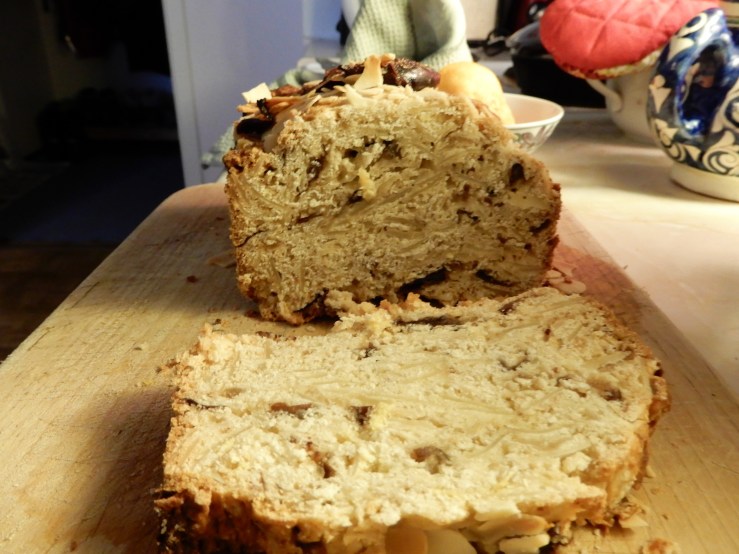
This coffee cake or quick bread has been a festive season favorite of my boon companion and me ever since I clipped the recipe from a December issue of the Finnish home design and food magazine Koti ja keittiö several years ago and gave it a try. Since then I have baked it something like a dozen times.
It is incredibly easy to bake and tastes great, especially with a cup of tea or coffee or cocoa amid the now nearly perpetual gloom of the slushy southern Finnish winter.
I am glad I clipped the recipe way back then, because the magazine’s website doesn’t seem to have a recipes archive. Fortunately, a smart looking blog entitled Idealista.fi has preserved the recipe for posterity in Finnish.
I have englished it, below, using standard English measures as well, rather than the metric measures used in Finnish recipes and cookbooks.
Finnish Festive Season Almond Date Bread
Ingredients
| Approx. 1 2/3 cups | White baking flour |
| 1 ½ tsp | Baking powder |
| 6 Tbsp | Sugar or fructose |
| 1 tsp | Coriander powder |
| Zest | Lemon (one whole) |
| Approx. 1 ½ cups | Dates, fresh, pitted, chopped |
| Approx. 1 cup | Almonds, flaked (NB. This is my substitution.) |
| ½ cup | Butter or margarine |
| ½ cup | Milk |
| 2 | Eggs |
| 2 or 3 pats | Butter or margarine, for greasing bread pan |
1. Measure the flour, baking powder, and spices, including the lemon zest, into a large mixing bowl and mix them lightly but thoroughly.
2. Chop and pit the dates if you have not already done it. It is up to you to decide how finely you want to chop the dates. I leave the almonds flakes whole, as they come out of the packapge, but you might want to give them a rough chop as well. In any case, set aside a small amount of the chopped dates and almond flakes for sprinkling on top of the bread just before it goes into the oven.
3. Melt the butter or margarine that goes into the bread dough. Add it and the milk to the mixture in the mixing bowl. Finally, add the eggs and mix the whole kit and caboodle until you have a smooth dough.
4. Grease a small rectangular bread pan. Spoon the dough into the pan and spread it around more or less evenly with a spatula. Sprinkle the surface with the dates and almond flakes you set aside earlier.
5. Bake in a 350 degree Fahrenheit oven for around 45 minutes to an hour. When the bread is done, let it cool for a while before serving.

Freely translated, tested, and photographed by Living in FIN

Koulu tukee mielikuvitusta,
meidät kävelytetään museoon.
Maalauksissa naiset kampaavat alasti ja selkä kyyryssä
keltaisessa huoneessa. Teema on toistuva.
Pellot lämpiävät lanteilla, auringonkukat
kiertyvät henkensä kaupalla kohti sineä, himon silmää.
Taivaalla kultaiset, raskaat kehykset.
Simpukkasuu kääntyy ja kuiskii pienin hengenvedoin:
Kuolenko mä kun mä en saa unta?
Jossain käynnistetään sirkkeli
ja ajattelen terää joka viiltää nopeasti ja syvään.
Joku sanoo hys ja simpukkasuu lopettaa:
Ei mulla muuta moi.
Menemme museon myymälään ja alan etsiaä julistetta seinälle.
Simpukkasuun sormet ovat hikiset sipulinvarret
ja hänen kaulansa ulottuu joka hetki ylemmäs,
puut, metsät enää vain kukkakeppejä, niin korkealle hän venyy.
Ajattelen terää joka viiltäisi niin nopeasti ja syvään,
että kaikki muu tuntuisi sillä hetkellä yhdentekevältä.
Enkä minä julistetta täältä löydä, myöhemmin vasta,
vuosien päästä kun se on valmis.
•••••
School encourages the imagination.
They walk us over to the museum.
In paintings, naked women comb their hair, backs hunched,
in a yellow room. The subject is recurrent.
Hips warm the fields, the sunflowers
turn their breath in spades towards the blue, the eye of lust.
The heavens are chockablock with heavy golden frames.
The clamshell turns and whispers, slightly gasping,
“Do I die when I cannot sleep?”
Sometimes a circular saw kicks in,
and I think of a blade that slashes quickly and deeply.
Someone says “Hush!” and the clamshell wraps it up,
“I haven’t got anything else. Cheers.”
We go to the museum store, and I look for a wall poster.
The clamshell’s fingers are sweaty onion stalks,
and her neck extends higher each instant.
The trees and forests are mere beanstalks, she stretches so high.
I think of a blade that slashes so quickly and deeply
everyone else would feel indifferent at that moment.
Nor do I find a poster there. Only later,
after years when it was ready.
—Vilja-Tuulia Huotarinen, Sakset kädessä ei saa juosta (WSOY, 2004), p. 45. Translation and photo by Living in FIN. Dedicated, belatedly, to Alexander Skidan on his birthday.
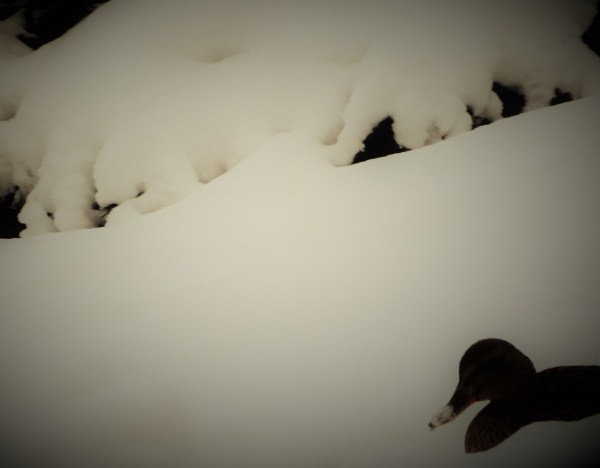
Äidinkielen tunnilla luetaan AI, YÖ, UI.
Ei siitä viisaaksi tule, mutta valitettavasti ei hulluksikaan.
Luistinradan takana on tilaa tapella.
Niitä kiusataan, jotka uskovat liikaa
sekä Mari-Orvokkia.
Näkinkenkärintainen tyttö kutsuu jäälle paritanssiin.
Tirsk tirsk sahaamme samaan suuntaan piirin poikki.
Äidinkielen tunnilla käännetään sivu.
OI EI, AL-LI, EI VOI.
Koulun jälkeen kävelemme pakkasessa kanalaan,
kuljetamme kananmunan huopien välissä patjan alle
ja sidomme viiden villahuivin sisään.
Jonain päivänä tapahtuu: kuori kopsahtaa rikki
ja linnunpoika rääkäisee ensimmäisen kerran.
§§§§§
In Finnish class, we read ouch, night, swim.
It won’t make you smart, but unfortunately it won’t make you crazy.
There’s a place for fighting behind the skating rink.
They bully Mari-Orvokki
and the ones who believe too much.
A seashell-chested girl invites me on the ice for a pairs dance.
Giggle, giggle, we saw across the circle in the same direction.
We translate a page in Finnish class.
Oh no, oldsquaw, cannot.
After school, we walk to the henhouse in the cold.
We carry an egg between blankets and put it under a mattress
wrapping it in five wool scarves.
Someday it will happen: the shell smashed to smithereens,
the chick will let loose its first squawk.
—Vilja-Tuulia Huotarinen, Sakset kädessä ei saa juosta (WSOY, 2004), p. 41. Translation and photo by Living in FIN

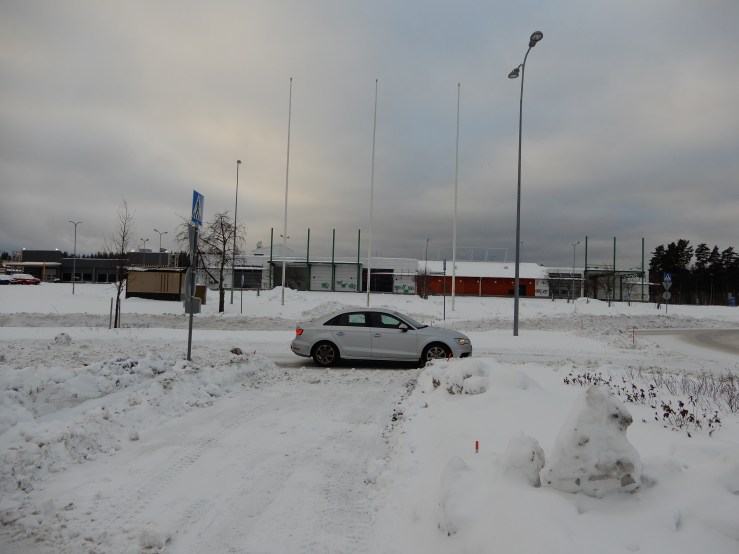
The urban planning geniuses who run Imatra, South Karelia, have re-purposed the former Prisma supermarket in the town’s Linnala (Mansikkala) neighborhood. They have given it over to the mysterious tribe of sub-artists known as taggers. Soon, I expect, the building will be entirely blanketed with these cryptic spray-painted runes, signifying nothing except the onset of urban decay and the collapse of public order.
Unless I am terribly mistaken, neither the building’s owners nor city officials have plans for doing anything more ambitious with the ex-store, yet another huge slab of empty commercial space. Imatra is now chockablock with such vacated stores and offices.
Currently being tagged into oblivion by young people who fancy themselves rebels but are among the dullest conformists on earth, the old Prisma store is smack dab across the street from the new Prisma hypermarket, which was built for Russian shopping tourists, not for local residents, whose peace of mind and quality of life dropped through the floorboards during the two or three years it took to build the gigantic consumerist palazzo, the city’s largest chunk of commercial real estate.
But it was all worth it. Anything giant construction companies, urban planners, and semi-monopolies (e.g., the S Group, which owns the Prisma chain and approximately fifty percent of all other chain stores, restaurants, and hotels in Finland) wants to do, wherever it wants to do it, and whatever its impact on the people living in the vicinity, it is always worth it.
And you should see the improvements to the neighborhood occasioned by the S Group’s flat-roofed ziggurat!
Do you know the expression “adding insult to injury”?
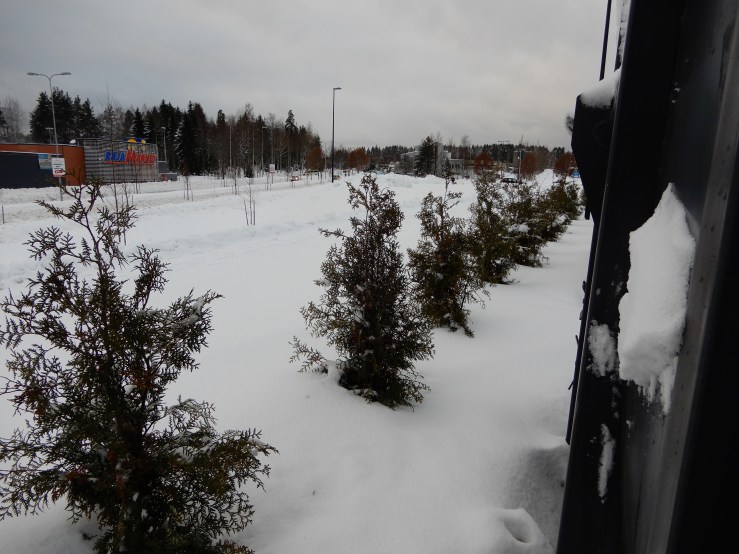
That seems to have been the principle guiding the hackwork done by subcontractors and the City of Imatra when they beautified, so to speak, the wave of mutilation that had just rolled over the neighborhood.
First, they made it triply difficult for pedestrians and cyclists to negotiate their old haunts by constructing an impossible maze of new roads, footpaths, and roundabouts in the emerging shopping mecca. (Since the new Prisma opened, chain stores Tokmanni and Jysk got in on the act, closing their old stores in other parts of town and building new outlets in the once spacious but now crowded neighborhood, thus joining the nonstop shopping party started eight or so years ago by K City Market, Lidl, Raja Market, and Prisma).
To put it crudely, they made life easier for motorists at the expense of non-motorists. Or they forgot about non-motorists altogether, which is more likely.
Planners also dotted the environs with sickly little trees, some of them resembling nothing so much as unattractive sticks, stuck maliciously into the dirt by angry taggers or other vandals, or the pathetic Christmas tree that Charlie Brown and Snoopy buy in the cartoon A Charlie Brown Christmas, which immediately sheds all its needles when they bring it home.
This so-called greenery will never grow into anything verdant and flourishing, because that might block the view of the stunning big box the S Group plopped down in the middle of what used to be a grassy meadow and grove of tall trees where old folks and children would ski in the winters. That is, before the City of Imatra decided that attracting Russian shoppers was its only real mission and it could safely turn its back on its own pedestrians, cyclists, children, old people, and poor people.
Photos by Living in FIN
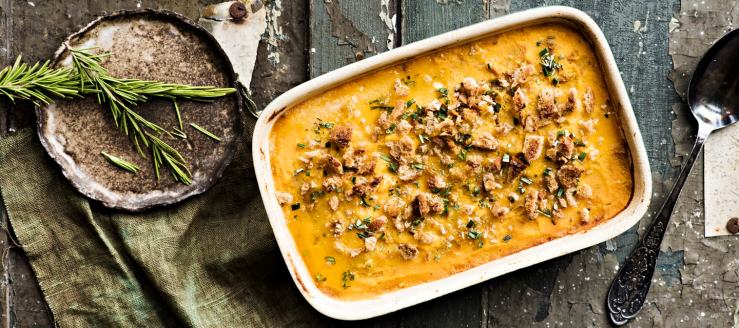
Finnish Butternut Squash Casserole
No Finnish holiday table would be complete without several casseroles (laatikoita), made from carrots, rutabagas, potatoes, liver, squash, and other gifts of the harsh Finnish soil and dogged agricultural labor.
Ingredients
| 2 | Butternut squash |
| 1 ½ cups | Water |
| 1 cup | Light cream (10%) |
| 2 tsp | Fennel seeds |
| 1 | Egg |
| 1 | Orange |
| 1 ½ tsp | Salt |
| ½ tsp | Black pepper (ground) |
| 2/3 cup | French baguette (crumbled into tiny croutons) |
| 1-2 tsp | Rosemary (fresh, finely chopped) |
| 2 Tablespoons | Butter |
Directions
1. Cut the squashes in half, removing the seeds and the innards. Remove the outer rind and chop the squashes into smallish cubes. Put the squash cubes and water into a pot. Heat the pot and simmer with lid on for around 30 minutes or until the squash cubes are soft. Stir occasionally. When the squash cubes are soft, remove them from the water with a ladle and put them into a mixing bowl. Puree them with a mixer or potato masher.
2. After the squash puree has a cooled slightly, mix in the cream and egg.
3. After washing the orange thoroughly, grate ½ teaspoon of zest from the rind and squeeze 3 tablespoons of juice. Crush the fennel seeds using a mortar and pestle. Mix the zest, juice, crushed fennel, salt, and pepper into the puree.
4. Pour the puree into a buttered ovenproof casserole or baking dish. Sprinkle the bread crumbs and finely chopped fresh rosemary over the top. Add a few pats of butter.
5. Bake at 300 degrees Fahrenheit for one to one and a half hours. In the final few minutes of baking, you can raise the temperature to 400 degrees Fahrenheit if you want the croutons to get more color.
Estimated overall preparation and cooking time: 60 minutes.
Source of text and photo: k-ruoka.fi. Translated and tested by Living in FIN

Valokuva otetaan valkeassa hameessa,
risti selkäpuolella ja polvi ruvella.
Kun tähtäin tarkentuu, kamera tärähtää;
that is me. Sunnuntaina vietetään juhlat
hauskanpidon ehtojen mukaisesti:
jalkoja ei saa laahata eikä juosta,
ei koska sakset kädessä
tai silmät puhkee.
Kävelen vieraiden joukossa viikatusti
ja käyttäydyn kuin hullut käyttäytyvät,
yritän olla normaali.
Seuravaana päivänä on jo syksy.
Lumisade laskeutuu korvilleni,
vaimentavat kuulokkeet, en saa jäseniä
laukeamaan vaikka niin tulisi lämmin,
istun valokuvassa hymyilevänä
ja ruusukimppu solisluutani vasten
ei kestä yhtäkään katsetta,
on niin hauraaksi jäätynyt, niin tyylikäs.
¶¶¶¶¶¶¶¶
The picture is taken in a white skirt,
cross on the back and scab on the knee.
When the viewfinder is focused, the camera jolts:
that is me. The Sunday celebration is observed
in terms of having fun:
do not drag your feet or run,
never walk with scissors
or you will poke someone’s eyes out.
I walk among the guests creased
and behave like crazy people behave.
I try to be normal.
The next day is already autumn.
Snowfall alights on my ears,
muffled headphones. Even if it were to warm up,
I could not get my limbs to relax.
I sit smiling in the picture,
and the bouquet of roses against my clavicle
cannot withstand a single gaze,
it is so delicately frozen, so stylish.
—Vilja-Tuulia Huotarinen, Sakset kädessä ei saa juosta (WSOY, 2004), p. 16. Translation and photo by Living in FIN.
P.S. For my sister, belatedly, on her birthday. LIF
Eeva Kilpi
Laulu rakkaudesta puihin ja eläimiin
Nyt minä laulan rakkaudesta
puihin ja kukkiin ja eläimiin.
Pysähdy, katso, ne vaarassa ovat,
suojele niitä, oi suojele niitä.
Tervehdi kukkaa, kumarra sille,
polvistu lehdokin edessä.
Anna sen kasvaa, älä taita ja tallaa,
se kuihtuu sinun vaasisi vedessä.
Anna sen kasvaa, anna sen olla,
se on olento siinä kuin sinäkin.
Joka ruoho tuntee, joka eläin pelkää,
se on kohtalotoveri ihmisen.
Minä laulan sinulle rakkaudesta
puihin ja metsiin ja harjuihin.
Pysähdy, katso, ne silmissä siintää.
Oi, että siintäisi vastakin.
Ei ole ihminen tuhonnut vielä
kaikkea metsää, onneksi ei.
Pahaa on tehty, paljon on mennyt,
niin monta korpea ahneus vei.
Vaan yhä minä laulan voimasta jonka
vain metsä voi antaa sydämeen,
voimasta joka saloilta huokuu
avuksi tuskaan ja sairauteen.
Oi veljeni kuusi, siskoni koivu,
mäntyni, haapani, leppäni oi,
vaahtera, paju, paatsama, tuomi,
pihlajat, katajat kansani,
joukkoonne minut ottakaa mukaan,
syliinne minut sulkekaa,
suruni teidän suruunne liitän,
hätäni teidän kanssanne jaan.
Yhä kukkii niitty, lentää höyty,
puhkeaa silmu ja lehti ja nuppu,
yhä venyy norkko ja punertaa käpy,
tuoksuu neulanen, pihka ja suo.
Olen mutaa ja suota, olen sieni ja sammal,
olen mättäällä karpalo, lakka ja kyy.
Samaa kipua kannan, samoin säikyn ja pelkään,
minä pyydän vain olla, en osta, en myy.
Minä laulan vielä rakkaudesta
lintuihin, mäyriin ja ilveksiin.
Ne vaarassa ovat, kuolema vaanii,
suojele niitä, oi suojele niin.
Eläimen silmistä jumala katsoo
sinua silmiin, tunnetko sen?
Älä käänny pois, älä pakene, torju,
kohtaa totuus surullinen.
Kohtaa eläimen jumalan-katse,
sinulta apua pyytää se nyt.
Rauhaa ja oikeutta se vaatii,
Jumala sortoon on kyllästynyt.
Jätä lehdot ja kummut jumalan käydä,
rannat jumalan soudella,
jumalan lentää ja jumalan kukkia,
jumalan uida ja pöristä.
Vapauteen vangittu elämä kaikki,
ihminen, kahleet kaikilta pois!
Ei ole luonto vain ihmistä varten,
luonto on luojasi, muista se.
Oi veljeni puu, oi siskoni heinä,
oi sukuni suuri: eläimet.
Samaa kudetta ollaan, samaa verta ja tuhkaa,
samaa ahdistusta ja unelmaa.

Eeva Kilpi
A Song of the Love of Trees and Animals
Now I shall sing of the love
of trees and flowers and animals.
Stop and look: they are in danger.
Protect them, o protect them.
Greet the flower, bow to it.
Kneel before the grove.
Let it grow: don’t trample and break it.
It will wither in your vase’s water.
Let it grow, let it be.
It is a being in the same way you are.
Every blade of grass feels, every animal knows fear.
It shares man’s plight.
I shall sing to you of the love
of trees and woods and ridges.
Stop and look: they loom before your eyes.
Oh, would that they would go on looming.
Man has not yet destroyed
all the woods, fortunately.
Bad things have been done, much has been lost.
Avarice has consumed so much wildnerness.
But still I shall sing of the power
only the forest can grant the heart,
the power emanating from the wilds,
helping us bear anguish and illness.
O brother pine, sister birch,
my pine, my aspen, my alder,
maple, willow, buckthorn, hackberry,
rowan, the junipers of my people,
take me into your throng,
enclose me in your embrace.
I shall join my sorrow with your sorrow,
I shall share my distress with you.
The meadow still blossoms, the fuzz flies.
Bud and leaf still burst open.
The catkin still stretches, and the cone reddens.
Needle, resin, and swamp are redolent still.
I am mud and swamp. I am mushroom and moss.
I am cranberry, cloudberry, and viper in a hassock.
I endure the same pain. I spook and scare the same way.
I just ask to be. I neither buy nor sell.
I shall also sing of the love
of birds, badgers, and lynx.
They are in danger: death stalks them.
Protect them, o protect them.
God looks through animal’s eye
into your eyes. Do you feel it?
Don’t turn away, don’t run away—fight back.
Face the sad truth.
Face animal’s God-gaze.
It asks you now for help.
It demands peace and justice.
God is weary of the oppression.
Let God’s groves and hillocks grow.
Let God’s beaches go for a row.
Let God fly and let God flower.
Let God swim and buzz.
Free all captive life,
man, remove the chains from everything!
There is no nature for man alone.
Remember nature is your creator.
O brother tree, o sister grass.
O my great family of animals.
We are made of the same weft, the same blood and ash,
the same anguish, the same dreams.
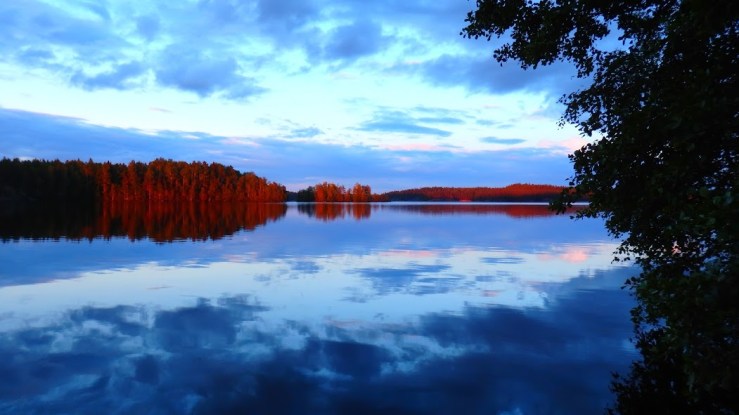
Originally published in Eeva Kilpi, Animalia (WSOY, 1987). Translation and photos by Living in FIN

Viimeinen päivä.
Ja säätiedotuskin niin kaunis:
Lämmin lounaan ja lännen välinen ilmavirtaus
vallitsee Suomessa.
Lähtiessäni totean:
pietaryrttejä piha täynnä.
Koko kesän olen lukenut:
tulee, ei tule, rakastaa, ei.

The last day.
The weather forecast is so beautiful.
A warm southwesterly westerly wind
prevails over Finland.
As I leave I note
the yard is full of tansies.
I counted them the whole summer long.
Loves me, loves me not. He’ll come, he won’t.
Originally published in Eeva Kilpi, Laulu rakkaudesta ja muita runoja (WSOY, 1972). Translated by Living in FIN. Photos courtesy of Luonnossa
Finland’s 100th Independence Day is almost over, but I wanted to say happy birthday to my favorite country by exercising a little of the independence it has afforded me by giving me a whole new language, a language I never imagined I’d be learning until nine years ago, and the miracle of meeting wise, tender, witty souls in the medium of that language.
I’m especially grateful to Finland and Finnish for acquainting me with the great Finnish writer Eeva Kilpi, whose novels, short stories, memoirs, essays, and poems should be translated into more languages. They are mostly as dissimilar as two writers could be, but occasionally she reminds me of the great Czeslaw Milosz. But mostly she reminds me of herself, which is always the real sign of a great writer.
This is just the next poem from her first collection, A Song about Love and Other Poems, published in 1972 (after she was already famous for her prose works), which I’m now translating all the way through.
It’s not patriotic at all, and has nothing to do with Independence Day, but it does have something to do with independence. LIF

Nyt minä lopulta rohkaisin mieleni,
soitin hänelle lennättimestä ja sanoin:
Tämä on Eeva Mikkelistä päivää.
Mitä sinulle kuuluu?
Minä lähden tältä kesältä torstaina.
Houkuttaisiko sinua sitä ennen
tulla vielä kerran käymään täällä?
Minulla on kiireitä, hän sanoi, ikävä kyllä,
eikö sinulle sopisi joskus myöhemmin syksyllä?
Riippuu pääskysistä, minä vastasin,
jos ne ehtivät lähteä ennen minua,
suljen ikkunan enkä enää tule.
Vai niin, hän sanoi. Mitenkähän se oikein on,
minulla hälyttää nyt valitettavasti toinen puhelin.
Mutta kun tulet kaupunkiin niin otetaan yhteyttä.
Suon kohdalla muistin miten se oli:
Laurilta laumaan, Pertulta pois.
Ja minä olin meinannut jo Maunona.
•••••••
I finally plucked up my courage.
I called him from the telegraph and said,
This is Eeva, calling from Mikkeli, hello.
How are you?
I’m wrapping up the summer on Thursday.
Could you be tempted before then
to come here again for a visit?
Sadly, he said, I’m busy.
Would it work for you sometime later in the fall?
It depends on the swallows, I replied.
If they manage to leave before me,
I’ll close the window and not come back.
Is that so? he said. Whatever the matter is,
unfortunately, my other phone is buzzing now.
But when you come to the city, we’ll get in touch.
Under my breath I remembered how the saying went.
“The birds flock on Lauri’s, and fly away on Perttu’s.”
And I was going to be a Mauno.*
* In the Finnish Lutheran calendar, Lauri’s nameday is August 10, while Perttu’s nameday is August 24. Mauno’s nameday is August 19. The equivalents of these men’s first names in English are Lawrence, Bartholemew, and Magnus.
Originally published in Eeva Kilpi, Laulu rakkaudesta ja muita runoja (WSOY, 1972). Translated by Living in FIN. Photo courtesy of Irman Kuvia
 Living in FIN