Valokuva otetaan valkeassa hameessa,
risti selkäpuolella ja polvi ruvella.
Kun tähtäin tarkentuu, kamera tärähtää;
that is me. Sunnuntaina vietetään juhlat
hauskanpidon ehtojen mukaisesti:
jalkoja ei saa laahata eikä juosta,
ei koska sakset kädessä
tai silmät puhkee.
Kävelen vieraiden joukossa viikatusti
ja käyttäydyn kuin hullut käyttäytyvät,
yritän olla normaali.
Seuravaana päivänä on jo syksy.
Lumisade laskeutuu korvilleni,
vaimentavat kuulokkeet, en saa jäseniä
laukeamaan vaikka niin tulisi lämmin,
istun valokuvassa hymyilevänä
ja ruusukimppu solisluutani vasten
ei kestä yhtäkään katsetta,
on niin hauraaksi jäätynyt, niin tyylikäs.
¶¶¶¶¶¶¶¶
The picture is taken in a white skirt,
cross on the back and scab on the knee.
When the viewfinder is focused, the camera jolts: that is me. The Sunday celebration is observed
in terms of having fun:
do not drag your feet or run,
never walk with scissors
or you will poke someone’s eyes out.
I walk among the guests creased
and behave like crazy people behave.
I try to be normal.
The next day is already autumn.
Snowfall alights on my ears,
muffled headphones. Even if it were to warm up,
I could not get my limbs to relax.
I sit smiling in the picture,
and the bouquet of roses against my clavicle
cannot withstand a single gaze,
it is so delicately frozen, so stylish.
—Vilja-Tuulia Huotarinen, Sakset kädessä ei saa juosta (WSOY, 2004), p. 16. Translation and photo by Living in FIN.
P.S. For my sister, belatedly, on her birthday. LIF
Viilenee hitaasti,
miedot tuoksut kohoavat aaltoina.
Valvoa myöhään, herätä varhain,
olla jouten koko pitkän päivän.
Mutta jokin huolestuttaa.
Ehkä kadonnut taito päästä irti asioista,
jotka eivät tapahdu täällä.
* * * * * * * * * *
It cools slowly,
the mild smells rising like waves.
Staying up late, waking up early,
being idle the livelong day.
But something is unsettling.
Perhaps the lost art of getting loose of things
that did not happen here.
—Hannu Salakka, Kesä kesältä syvemmin (Otava, 1977), p. 36. Translation and photo by Living in FIN.
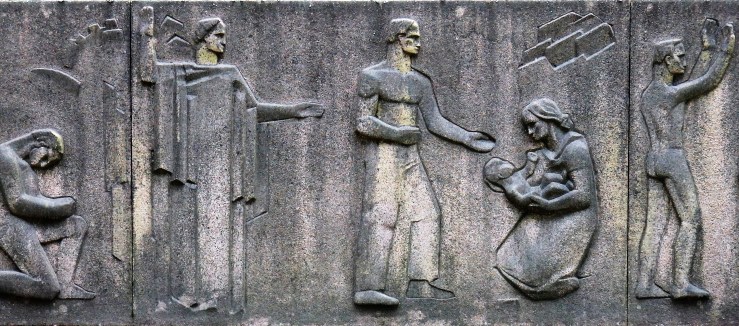
A few years ago, citing “numerous” complaints from the “general public,” the Imatra municipal parks and maintenance department summarily loaded the lovely brutalist modernist sculpture in the middle of the picture, above, onto a flatbed truck, took it to the local rolled steel plant, and melted it down in the plant’s blast furnace.
It was left to the Imatra municipal culture department, which had not been warned by the parks and maintenace department it was planning to commit this act of iconoclasm, to telephone the sculptor, who is quite famous in Finland and alive and well in Helsinki, to explain what had been done to his artwork by the yahoos in Karelia. It was reported that he took the strange news quite well, all things considered. LIF
Ms. Lintunen has traced the lives of women in the Pori area who fought for the Reds during Finland’s brief civil war (1918) and the aftermaths of their decisions.
As Ms. Sotejeff-Wilson writes in her conclusion, Ms. Lintunen’s book seems to be a perfect candidate for translation into English, especially in this centennial year. (Finland is celebrating 100 years of independence this year.)
“The immediate consequence was often months of waiting—if not dying—in near-starvation conditions in prison camps before their case went to court. The daughter of one woman, Katri, remembers the story of how her mother stole fresh bread from her own mother’s kitchen and was hysterical when her little sister wanted to leave the house with red ribbons in her hair. Katri was sure that her sister would be arrested for openly supporting the Reds. Another woman remembers her teacher knocking a boy’s head against a brick wall for taking 1 May, the international workers’ day, off school.”
In my adopted semi-hometown of Imatra, there is a war memorial, seemingly leftist in its aesthetic, and twelve headstones at the city’s cemetery. They sit cheek by jowl with the clearly delineated, amply identified part of the cemetery where the “real” Finnish war heroes lie, i.e., men who died fighting the Soviet Union in the Winter War and the Continuation War.
“Leftist” memorial and gravestones to twelve “non-heroes” of the Finnish Civil War, Tainionkoski Cemetery, ImatraThe section where those who fought and died against the Soviet Union lie in rest is much better looked after and more clearly identified. Tainionkoski Cemetery, Imatra
Until quite recently, all the names and dates of the dead and brief details of their deaths were listed on large laminated sheets of paper, hung behind glass in a information stand situated midway between the two memorials.
“Tainionkoski [Cemetery] War Graves.” This schematic is keyed to the lists of the war dead, most of them local soldiers and officers who fought in one of the two wars against the Soviet Union from 1939 to 1944. The twelve graves situated perpendicularly and at a distance from the main mass of war graves are marked on this schematic, but the men and one woman who lie in those graves are no longer listed on the information stand, although only a few years ago they, too, were deemed worthy of inclusion in the list of war heroes.All the local men who perished the Winter War and Continuation War are still listed on the information stand, as are their dates of birth and death, as well as their exact location in the “heroes” section of Imatra’s Tainionkoski Cemetery. But you will find no information about the war dead buried nearby, eleven men and one woman, who were most likely executed by the Whites during the waning days of the Finnish Civil War.
Then, about a year or two ago, the names of the twelve—who most likely were Finnish Reds executed during late April and early May 1918 at Ruokolahti, near present-day Imatra, if my memory serves me as to what was written on the old lists—were mysteriously removed from the stand.
When I last visited the cemetery again, a week or two ago, the graves of the twelve “traitors” seemed to have been spruced up a bit. The names and dates engraved on the headstones had been outlined in white to make them more legible, but their bearers were still absent from the laminated list of heroes in the information stand, and there was nothing but the memorial behind them that would suggest to anyone who they were and what side they could have fought on.
This is all Imatra’s Tainionkoski Cemetery has to tell us about Amanda Knutars, who was, I seem to remember, executed near Ruokolahti (which in the administrative toponymy of that era, before Imatra and Ruokolahti were incorporated as full-fledged municipalities, could have been almost literally down the street). It also strikes me as odd that the modest headstones of her and eleven companions in death are marked with crosses. Were they Reds or Whites? Or is the current generation too modest to tell us plainly, passing off Reds shamefacedly as “good Christians”?Meanwhile, nearly all the gravestones marking the final resting places of the “real” heroes bear traces of the German Junker aesthetic that has been all too prominent in the insignia and symbolism of the Finnish Army, even to this day.
I am sure the memorial to the twelve, by the way, is no longer legible to the younger generation, i.e., people born after 1991, just as the motto etched on its base, something about “brotherly sacrifice” has long been overgrown with moss.
The only real clue to their identities is the fact that members of the Finnish Social Democratic Party march to the Tainionkoski Cemetery very early in the morning every May first and place a wreath at the memorial before going to have their Mayday coffee and roll. Next year, I am marching with them.
Update (14 April 2020). Today, quite by chance, I happened upon a useful website, Punaisten Muistomerkkit (“Red Memorials”), which has an entry on this particular memorial. Designed by Veikko Jalava, it was erected in the 1960s by the local Social Democrats when the paper and pulp manufacturer Enso Gutzeit (now known as Stora Enso) decided to build a new plant near the site of the former Harakka sawmill lumberyard, where the twelve had been buried. Their remains were dug up and transferred to the Tainionkoski Cemetery.
Pieraista kovaa omassa tuvassa.
Joskus sitä on valmis epäröimättä
uskomann kapitalismiin.
* * * * * *
Fart hard in your own hut.
Sometimes it is unhesitatingly ready
to believe in capitalism.
—Eeva Kilpi, Runoja 1972–1976 (WSOY, 1978), p. 40. The poem was chosen using the True Random Number Generator at random.org. Photo and translation by Living in FIN
* * * * * *
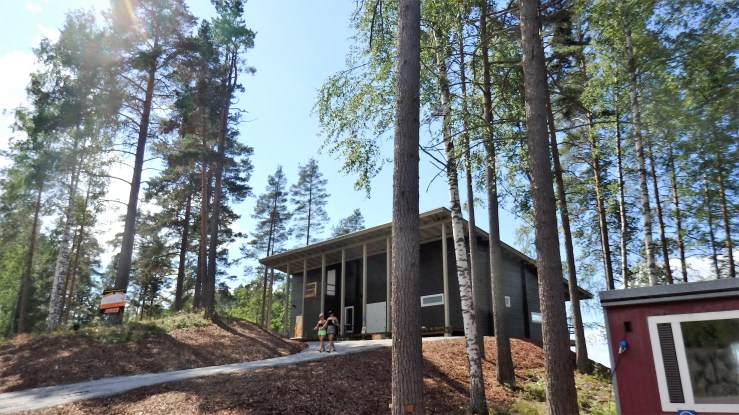
The photo, above, is of an empty “fish restaurant,” built near Ukonniemi Beach on Lake Saimaa in Imatra, South Karelia, by the city government and their favorite private contractors at great expense to the once-beautiful natural environment and local taxpayers.
Although no restaurateurs had agreed to lease or operate the future restaurant when the project was mooted and approved by city planners and city councilors, the constructionn of the “fish restaurant,” which involved felling hundreds of trees, building black-topped car roads where once there had only been soft footpaths, and dozens of other kinds of deviltry disguised as “landscaping” and “improvements,” went ahead anyway.
The initial phase, the destruction of the original, gorgeous landscape, ran into considerable cost overruns, and project managers found themselves asking the city for more money to keep up their wave of mutilation.
Several years later, no one has emerged operate or lease the restaurant, although the building is ostensibly ready to fry up fish fingers and put them all in a line.
The restaurant would be a great opportunity for any shyster who wants to go in and out of business in less than a year, because the wonderful Nuotta Restaurant and Smokehouse, located on the other side of Ukonniemi Beach, has been doing land-office business ever since it added a rooftop terrace last summer.
The food and atmosphere at the Nuotta are nonpareil, as all its regular and irregular customers know, and its view of Imatra Harbor and Laimassaari is stunning. On a warm, sunny day, I could sit there for hours, just sipping a glass of wine or a cup of coffee.
Even my dog thinks Nuotta is the cat’s meow. He once forced me to go there, after a long walk through the forest, so we could sit there for half an hour and just inhale the view. I had to order a cup of coffee and a doughnut to justify our odd-couple presence on the veranda. My dog was immeasurably pleased.
So why would such a tiny harbor need another fish restaurant? This isn’t “innovation,” as the current so-called bourgeois Finnish government would call it. This is sheer stupidity that was egged on local decision-makers by the construction lobby, who are always trying to drum up new projects for themselves, whatever cost to the built heritage, environment, and taxpayers, and whether their dubious improvements are really needed by flesh-and-blood, paying customers and townsfolk or not. LIF
Avataan lahjapaketti, ahmitaan suklarasia.
Nuolaisen ennen kuin tipahdan.
Kieli on kylmä lusikka kieltä vasten,
taipuu kun taivutan,
matolla minttuliköörin soma lemu
ja finni nenänpäässä,
yksi kukkavihkosta ilmestynyt nätti orvokki.
Nipistän ihon pintaa ja siihen herahtaa mustelma.
Mikään täällä tuskin on unta,
Jon Bon Jovi vilkuttaa seinällä silmää
kun puen farkut,
pyyhin viimeiset kärpäset suupielistä.
On liian myöhäistä
nukahtaa nyt,
ripustan rintaliivit kattolamppuun.
Ja lamppu sammuu.
Ekakerta on merkittävä, muista ei niin väliä.
Katson käsivarttani kuin kannibaali satukirjan sivua,
otsa nojaa vasten eebenpuuta,
lumi putoo punaiseen katuun.
Vaikka miten päin kääntäisin päätä, suipistaisin suuta,
lyhtypylväät seisovat suorassa rivissä, niin suorassa
että pää tulee kipeäksi.
We open the gift package, wolf down the boxes of chocolate.
I lick before I drop.
The tongue is a cold spoon against the tongue,
it bends when I bend.
The sweet stench of mint schnapps on the carpet
and a pimple on the nose’s tip,
one cute pansy popped from the flowery notebooks.
I pinch the skin’s surface and a bruise wells up.
Hardly anything here is a dream,
Jon Bon Jovi winks on the wall
when I put on jeans,
I wipe the last flies from the corner of the mouth.
It’s too late
to fall asleep now,
I hang the bra on the ceiling lamp.
And the lamp goes off.
The first time is important, don’t mind so much about the others.
I look at my arm like a cannibal looking at a page in a storybook.
The forehead leans against an ebony tree,
snow falls on the red street.
Whatever way I turn the head, I purse the mouth.
The lamp posts stand in a straight row, so straight
I’m going to get a headache.
— Vilja-Tuulia Huotarinen, Sakset kädessä ei saa juosta (WSOY, 2004), p. 17
Meidän kullanruskeat päämme ovat kumartuneet
toisiaan vasten, kynä rapisee hiiren jälkiä, suu avautuu
välillä leijonan kokoiseen haukotukseen, mutta sieraimet
värähtävät valppaasti. Nyt tehdään salaisuuksia. Avaudutaan.
Liittoudutaan. Kuuntelen ekassa pulpetissa Eleanor Rigbya
joka laulaa ikkunalaudalla, jalat eivät mahdu enää
pulpetin alle, katson lasin läpi mustia haavoja
koivujen kyljissä, hiiltyneitä arpia tiukan valon syleilyssä.
Kun tunti loppuu ja sujautamme paperit reppuun,
näen hänen reunamerkintänsä: tähtiä marginaaleissa,
kirkkaita kovia terässiipisiä ikuisia.
Our golden-brown heads are stooped
towards each other, pencils scratch mouse tracks, mouths open
occasionally into lion-sized yawns, but nostrils
vibrate vigilantly. Secrets are made. They are revealed.
Alliances are formed. At the first desk I listen to Eleanor Rigby
singing in the windowsill. Legs no longer fit
under the desk. I look through glass at black wounds
on the birch sides, charred scars in the taut light’s embraces.
When the lesson ends and we slip our papers into rucksacks,
I see his edge markings: stars in the margins,
bright hard steel-winged everlasting.
— Vilja-Tuulia Huotarinen, Sakset kädessä ei saa juosta (WSOY, 2004), p. 42.
Photo of former Savikanta School (Imatra, South Karelia) and translation by Living in FIN
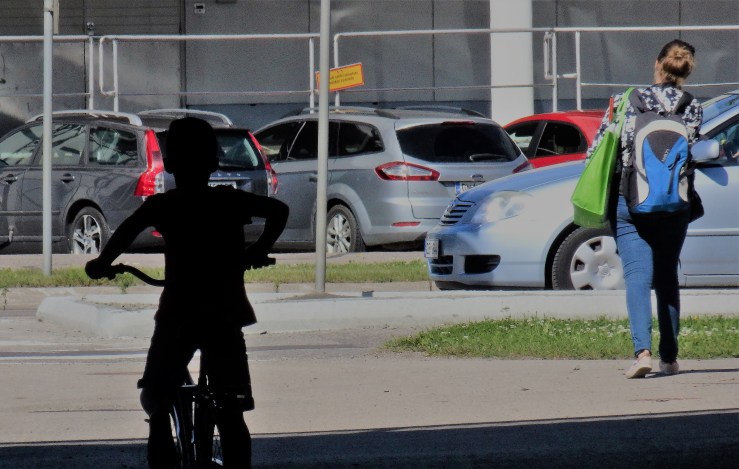
This is a snapshot of what bicyclists, pedestrians, and, sometimes, mopedists, do almost every livelong day to the flimsy piece of twine, draped with tiny flags, hung by the members of our co-op’s management board to prevent them from making this shortcut.
Why are the cyclists, peds, and mopeds so hellbent on taking this shortcut?
Because, a few years ago, the city government of Imatra, South Karelia, perhaps the wisest municipal government on Planet Earth, royally messed with the perfectly serviceable and intuitively natural network of footpaths and bike trails in our neighborhood to accommodate a new neighbor, a giant Prisma hypermarket, built exclusively for Russian shopping tourists, who at one point some years ago were surging through Suomi’s southern borders in droves, but since Putin decided to rule the world and tank his country’s economy in the process, have been reduced to a trickle.
In the wake of the hypermarket’s nearly sacred advent in our lives, we residents of Linnala, the Imatra micro-district that had this alien happiness shoved down its throat without much say-so, got all our streets, sidewalks, intersections, parking lots, footpaths, and bike trails “improved.”
In practice, this means they were turned into an impossible pile of spaghetti, in which you continually have to cross streets, car lanes, parking lots, and roundabouts (all of them newly installed at taxpayer’s expense), usually in a counterintuitive zigzag pattern, to go where you used to go much faster and without all the hassle.
This is the level of urban planning in South Karelia. If you don’t believe me, take a trip to the region’s unofficial capital, Lappeenranta, where they have also been rolling out a wave of mutilation to satisfy the itches and urges of Finnish architectural design and construction companies with names like Lemminkäinen, who have also long been in the business of transforming Russia’s second capital, Petersburg, with impossibly large and ugly residential blocks.
Because that is the bottom line: making a fast buck whatever it does to lives that people were perfectly happy with without ever saying so. When you mess with their lives in this way, blazing their old daily trails back onto the mostly invisible maps of their neighborhoods is their way of saying they were happy with the way things were. LIF
In the second weekend of August, Krimi will celebrate the houses’ last summer as a festival touchstone with an extravagant garden party. Let’s do it one more time, sisters and brothers!
The festivities officially kick off at 6 p.m. on Friday, August 11, with the opening of a show by painter Santtu Määttänen. The audience will be entertained after the opening by musical mastermind Joose Keskitalo.
On Saturday, partygoers can arrive at Krimi early in the day and spend quality relaxation time with the whole family if they like. The music again blasts off at nightfall, supplied by Joutseno-based power duo Suominen & Härkönen, multimedia Guggenheim Projektz, and Australian-born Kitto, a great singer-songwriter who now hails from Sweden.
In addition to music, on Friday and Saturday, Krimi will have a really special program featuring performances, caricature drawing, and a holographic piece by the Power Builders art group. Partygoers are also free to express themselves and bring games, musical instruments, etc. The party will be conceived and celebrated together.
A detailed schedule for the weekend will be available shortly, and other changes to the program are also possible. While admission to the event is officially free, we hope that participants support our work by donating money as they see fit.
General Info
The party is organized by the Krimi Art Center in cooperation with the Krimi Houses, located at Koulukatu 1A in Imatra. Except for Friday’s art show opening, the entire program will take place outside. With an eye to the fickle weather, it would be worth your while to bring warm, waterproof clothes just in case. You should also bring something or other for sitting on in the yard. In addition, the sauna will be warmed up on Saturday. Bring your own towel along if you want to have a bath.
There are plenty of shops and other services nearby. The nearest campground is around three hundred meters away, in Varpasaari Fishing Park. People traveling long distances may also ask to stay the night at Krimi.
If you have specific questions, you can contact us by email at taidekeskuskrimi@gmail.com.
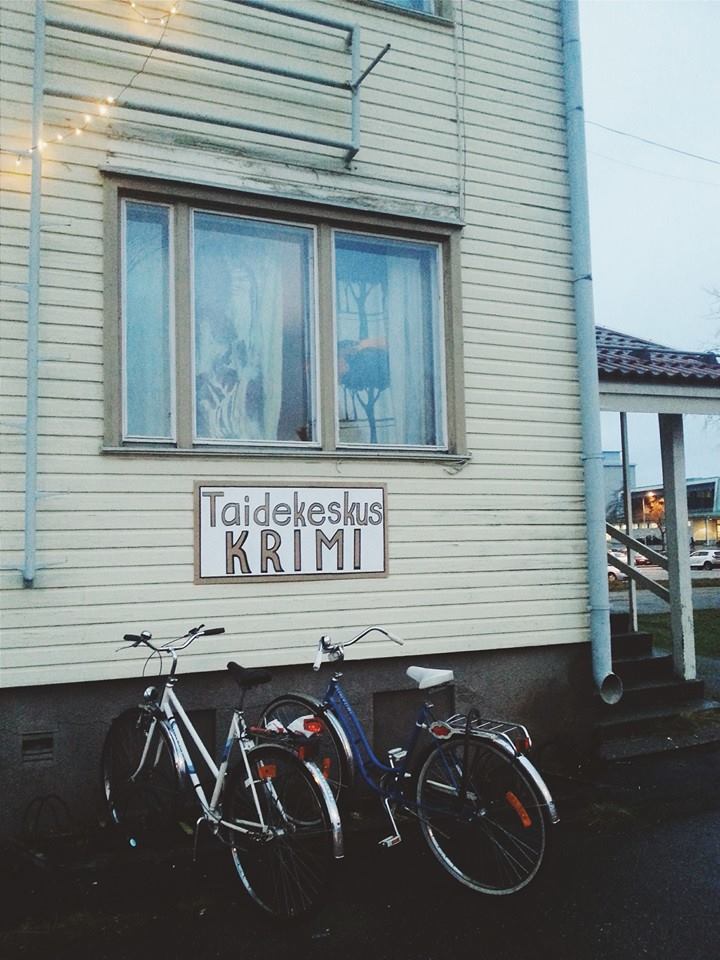
The Krimi Art Center, a home and haven for Imatra’s current art students and recent art school grads, celebrates its last summer in existence with a festival on August 11 and 12, 2017.
Why has the city decided to demolish the two modest wooden buildings that make up Krimi?
I’ve already forgotten the “official” reason the houses have to go (the dreaded “toxic fungus” that lumbers round this fair land like the plague during the Middle Ages? austerity for students at the hands of the current bourgeois government?), but I have no doubt they are at odds with the city’s current development plan, which involves
demolishing as much built heritage as possible, even officially listed built heritage;
holding as many loud, vulgar public mega events as possible, such as the recent “concerts in the park” that ripped up huge swathes of the parkland situated cheek by jowl with the complex housing the city’s library, concert hall, museums, and city hall, while sonically terrorizing the mostly elderly residents of the nearby Mansikkala neighborhood for several nights in a row, and the latest iteration of the Imatra International Road Racing Championship, an event that should have been left buried in the 1960s, when it crashed and burned, but has been unwisely dusted off by the local powers that be and made an annual fixture just as worldwide climate warming kicks into high gear, as if sending huge clouds of smoke into the atmosphere is now cooler than it was back in the swinging sixties;
building as many big box stores for the now-mostly nonexistent “flood” of Russian shopping tourists and building most of the stores in the same neighborhood, Mansikkala, thereby making life nearly intolerable for residents of the city’s most populous district, most of whom are old-age pensioners who built the place and, when they were still working, actually made real things in the city’s once-mighty factories;
building something useless or expensive or both in the so-called Imatra Free Time Center (Imatran Vaipaa-Aika Keskus), which was once a wooded paradise on earth, featuring a pine tree-shaded swimming beach so pretty and picturesque it made you want to cry. Nowadays, however, the Imatra Free Time Center is chockablock with vacation cottages, a revamped beach in which most of those shade trees have been axed, a biathlon center (soon to be useless in a warmed-up climate hardly capable of producing large quantities of snow), a new Finnish baseball stadium, an indoor sports field, sheltered by an inflatable dome, a new camping ground (moved there to make room for the vacation cottages), and a new fish restaurant, erected right on the shoreline of Lake Saimaa. Hilariously, the fish restaurant was blueprinted and built by the city and its allies in the construction sector even though it had no one lined up to lease and operate it after plans for it were mooted and officially approved and, now, at least a year after it has been built down to the last doorknob, the mythical fish restaurateur is still waiting in the shadows, too bashful to emerge and take over the eatery custom built for him or her. Construction of the fish restaurant (which, were I a bad, lawless person, I would suggest the soon-to-be-homeless art students and young artists from Krimi should squat, because it’s not serving any other purpose at the moment) necessitated the clear-cutting of so many trees and the pouring of so much asphalt that it changed beyond all recognition the particular tract of now-vanished shady forest on the shores of Lake Saimaa where it was plopped down to no apparent purpose. Basically, it turned that part of the Imatra Free Time Area into a “human-friendly” desert of the kind that puts Russian shopping tourists at ease, or so the local Finnish developers imagined. It never occurs to the local Finnish developers and city planners they could be wrong about anything, least of all about Russians, about whom they pretend to know everything, but about whom they know almost nothing, which would be ironic if were not so funny and sad at the same time;
attacking and annihilating nearly defenseless cultural and artistic endeavors like the Krimi Houses, the now-defunct Taiderastit one-day art crawls, the International Semiotics Institute and its renowned summer seminars, and other things that had made the town attractive to a different crowd of tourist, as well as to local residents who don’t celebrate soul-, eardrum-, and earth–destroying noise and smoke as “culture.” Needless to say, none of these events cost the city or the federal government much money at all, but they were easy targets for hard-minded city councilors, MPs, and deputy ministers wanting to produce results when it came to the most sacred thing in Finnish governance: “savings” (säästöjä)
Ukonlinna Beach, Imatra, South Karelia, 31 July 2012. Photo by Living in FIN
This is how the city of Imatra, South Karelia, Finland, imagines and actually implements its own future: by getting rid of lots of things and people that, in real and cultural terms, are defenseless, good value for the money, and anything but in-your-face aggressive and environmentally destructive, whether we are talking about trees and beautiful shorelines or mild-mannered art students running an art gallery in their own digs or foreign semioticians. The city replaces them with what is good in the very short term for the demolition, construction, and lowbrow tourism and shopping sectors.
And you thought Finland was different. How wrong you were. LIF






 Living in FIN