Ei mutta nokkoseni ovat jääneet kokonaan kehumatta.
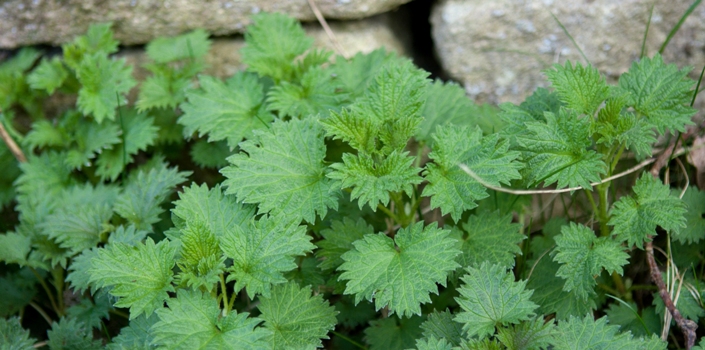
Nokkonenhan se on kesän viimeinen, sitkein
ja runsain kukkija.
Kauniit, rehevät röyhyt taivuttavat sen
aistikkaalle kaarelle
ja se nojaa kivijalkaa vasten
kuin lepuuttaen raskasta, koristeiden painamaa päätään
tai kuin iso koira olisi laskenut siihen leukansa,
karvaisena, pörröisenä, paijattavan näköisenä.
No, but my nettles have been left entirely unpraised.
The nettle, in fact, is summer’s last, its hardiest
and most abundant flower.
Lush, pretty panicles bend it
in an elegant arch,
and it reclines against a plinth,
as if resting its heavy, ornament-laden head,
or like a big dog that has laid its chin down,
hirsute, shaggy, and looking petted.
What about yarrows, hawkweeds,
September strawberry blooms?
Leave me in peace, poems. I am praying.
Source: Eeva Kilpi, Terveisin (WSOY, 1976), p. 35. Translated by Thomas H. Campbell. Photo courtesy of demuths.co.uk
Minä syön kaurapuuroa ja ruisleipää sen kanssa.
Lapsuus nousee mieleen. Uunipuurot. Kiisselit.
Aamiaisaika oli silloin kello yhdentoista maissa.
Se mitä nyt sanotaan aamiaiseksi oli aamukahvi
tai aamupuuro. Se oli “syö ennen lähtöäsi”.
Tai “aamuplöröt”.* Tai “mie haukkaan ens vähän jottain”.
Tai “elä lähe tyhjin vatsoin”.
Tai “kuhan on märkää ja lämmintä”.
Unessani olivat isä ja äiti nuoria
ja minä imetin lasta.
I’m eating oatmeal with rye bread.
Childhood comes to mind. Baked porridges. Kissels.
Breakfast time was around eleven o’clock then.
What they call breakfast nowadays was morning coffee
or morning porridge. It was “eat before you leave.”
Or “morning coffee with a shot.”* Or “I’ll have a bite of something first.”
Or “don’t leave on an empty belly.”
Or “get it while it’s moist and warm.”
In my dream, mother and father were young,
and I was breastfeeding a child.
—Eeva Kilpi, Kiitos eilisestä (WSOY, 1996)
* Plörö. A mixture of coffee and spirits, traditionally enjoyed as follows: 1. Place a coin on the bottom of the cup. 2. Pour coffee into the cup until the coin is no longer visible. 3. Pour liquor into the coffee until the coin is visible again. 4. Drink and enjoy! 5. Repeat or, alternately, remove the coin to a safer place.
Aamulla bussissa uninen tyttö
toiselle tytölle:
Miun pitää mennä kurseille Valkeekoskelle,
vaikka mie en tiiä missä se semmonen Valkeekoski
on,
kaipa se jostakin löytyy.
Asemalla kaljuksi ajettu mies
käveli pientä ympyrää ja puhui itsekseen.
Ihmiset saavat joskus merkillisiä ajatuksia.
Jo uutiskuvien kasvoista näkee,
että tässä maailmassa vain vanhat miehet
ovat kotonaan.
Jättävätkö he meille perintöä,
enemmän aikaa kuin heillä itsellään on jäljellä?
Käärmeiden pyydystämisestä ei ole hyötyä,
vastamyrkkyä ei löydetä.
Jos ydinsota todella käydään,
se päättyy siihen
että eloonjääneet syövät toisiaan.
Mita muutakaan syötävää heillä olisi?
Kun kävelin tiellä,
korviini tuuli,
jäiset puut napsahtelivat,
lumi narisi ja parkui.
Tiesin ettei ketään olisi kotona.
A sleepy girl on the morning bus
said to another girl,
“I gotta take classes in Valkeekoski,
even though I dunno where this Valkeekoski place
is.
Maybe it will turn up somewhere.”
At the station, a man whose head was shaved bald
walked in tiny circles and talked to himself.
People sometimes get peculiar ideas.
You can see from the faces in the news
that only old men are at home
in this world.
Will they leave us a legacy,
more time than they have left themselves?
There is nothing to be gained from snaring snakes
if no antidote can be found.
If nuclear war really takes place,
it will end with
the survivors eating each other.
What else would they eat?
As I walked down the road,
the wind blew in my ears,
the icy trees snapped,
the snow whined and blubbered.
I knew that no one would be at home.
Pikkulepinkäinen, mustakulmani,
suussaan iso keltainen perhonen, silmieni ilo,
puoliksi nieltynä, siivet harallaan nokassa,
ja koko tämä asetelma
sijoitettuna mahtavaan karhunputkeen,
taustalla ohdakkeitten hillitty sinipuna
jossa perhonen äsken lensi.
Ja minäkö ainoa tietoisuus?
En taatusti.
Tuskassa ja tyytyväisyydessä sen siemen jo on.
Red-backed shrike, my black-browed mollymawk,
a big yellow butterfly, joy of my eyes, in its mouth,
half-swallowed, the wings splayed in the beak.
And this whole still life
set in a prodigious wild angelica,
against the muted purple of the thistles
where the butterfly just flew.
And am I the only consciousness?
Certainly not.
Its seed is already there in the suffering and satisfaction.
Source: Eeva Kilpi, Terveisin (WSOY, 1976), p. 32. Translated by Thomas H. Campbell. Photo courtesy of Wikipedia
Aurinkoja on monta.
Me olemme liian kaukana toiveinemme
joiden emme uskalla antaa toteutua.
Valo joka lähti meitä tavoittamaan
on jo ohi
kun se saavuttaa meidät,
yhteen ääneen väitämme
että edes nuorina
emme pelänneet pimeää.
There are many suns.
We are too distant with our hopes,
which we don’t dare let come true.
The light that set out to meet us
has already passed
when it reaches us.
We claim in unison
that even when we were young
we were not afraid of the dark.
—Hannu Salakka, Vuoden viimeisenä ja ensimmäisenä yönä (Otava, 1996)
Ariel Massengale (left) and Samarie Walker play for the Lappeenranta Catz basketball team. Photo courtesy of Kai Skyttä and Etelä-Saimaa
Scary Elections
Kaisa Juntunen Etelä-Saimaa
November 4, 2016
Scary. Really scary. Teacher Elena Barrett, who hails from Connecticut, describes the US presidential election in these terms. Ohio basketball player Samarie Walker and her Illinois teammate Ariel Massengale use the exact same expression.
“I’ll move from the country if Donald Trump wins. I don’t want a sexist, racist president,” Walker blurts out.
Walker has already inquired about whether she can get a visa to Canada or England.
“I’ve lived in many countries, and moving doesn’t seem impossible at all.”
Walker and Massengale say many of their friends are having the same thoughts.
“But they are hardly serious. If a person hasn’t been outside her own state, she is not likely to move abroad,” says Walker.
Talk of moving speaks to the fact people are really scared.
“I’m afraid racism would increase and the position of blacks would become harder if Trump were in power,” says Walker.
Walker believes the circumstances of many other groups, such as gays, would become more difficult.
Trump’s belligerence also appalls Walker.
“It sounds bad that Trump would have decision-making power over nuclear weapons.”
Walker and Massengale think Hillary Clinton has the right priorities, such as equal rights and education.
Massengale says she has exercised her right to vote. Despite her tough opinions, Walker neglected to vote.
Elena Barrett teaches at the Lappeenrannan Lyseo Upper Secondary School. Photo courtesy of Elena Barrett
She earnestly hopes Donald Trump will not win. Barrett fears democracy in America will crumble if Trump comes to power.
“For a while it seemed Trump had no chance of winning, but the situation has changed now the FBI has begun to investigate Clinton’s emails again.”
Barrett believes the situation has tipped in an alarming direction and Trump may well win.
Even if Clinton won, the duel would not be over, in Barrett’s estimate.
“If Trump loses, he will hardly be satisfied with the outcome. For one, he would be in the media a lot, raising grievances and seeking to complicate Clinton’s job as president.”
Barrett has not voted herself.
“I’m resident of a state where the votes always go to the Democrats, i.e., Clinton, for whom I would have voted.”
Barrett supported Bernie Sanders in the primaries.
Barrett has noticed that Finnish high schoolers are very interested in the US elections and especially in Trump.
Translated by Living in FIN. The article was published in the print version of the newspaper (“Pelottavat vaalit,” Etelä-Saimaa, November 4, 2016, p. 6). The link, above, is to a slightly different version of the article published in the online edition.
Tuuli vie hiekkaa
ja pakottaa linnut tarrautumaan puihin.
Olen väsynyt kevään kalvamaan taivaaseen.
En muista hänen kasvojaan,
minulla oli silmää nähdä ainoastaan hänen
kauneutensa.
The wind carries the sand
and forces the birds to cling to the trees.
I am tired of spring’s galling sky.
I do not remember his face.
I had an eye for seeing only his
beauty.
—Hannu Salakka, Ennen kapaisin tähän (Otava, 1983)
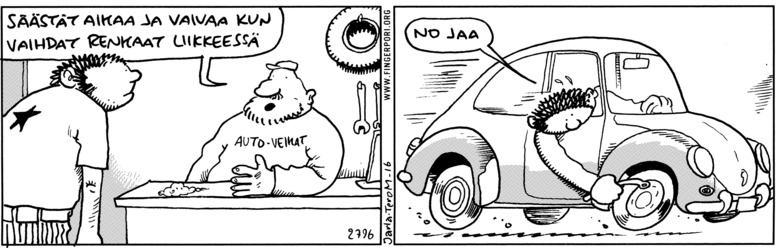
Living proof that Finnish is one of the world’s easiest languages is provided daily by the comic strip Fingerpori, written and drawn by Pertti Jarla since 2007 and syndicated in nearly all the daily Finnish newspapers I have ever read. If I am not mistaken, a few years back, Fingerpori overtook Viivi ja Wagner, which I have translated here on a few occasions, as the most popular comic strip in Finland.
Fingerpori‘s value for the Finnish learner is that nearly every strip is based on wordplay, double entendres, and the absurdity that arises when the characters take certain expressions literally or forget (like many tyros like me often do) that words can have entirely disparate meanings in different contexts.
Unlike Viivi ja Wagner, whose humor is based on Wagner’s charmingly uncharming piggishness and Viivi’s clear-eyed yet affectionate exasperation with her boyfriend’s endless faults and abysmal male chauvinism, Fingerpori cannot usually be translated in a straightforward way.
My fabulous former Finnish teacher Tiina has drawn my attention to this strip, in which the humor revolves around the word liike, whose basic meanings are “motion” and “movement,” on the one hand, and a “shop” or a “business,” on the other. Here it appears in the inessive case—liikkeessä. (Don’t ask me where the extra “k” and the extra “e” came from: it would take too long to explain.)
In the first panel, the auto mechanic advises the man on the left, “You will save time and trouble if you change [your] tires at a/the shop.”
Unfortunately, the man on the left has heard something else: “You will save time and trouble if you change [your] tires on the go.” Meaning, literally, while “in motion.”
In the second panel, we see the man trying mightily, indeed, to change his tires on the go.
“No jaa,” he says, probably in exasperation. “Oh well.”
I imagine it takes native Finnish speakers only a few milliseconds to get the joke. For Finnish learners, on the other hand, it is a test of our fluency or, at least, our ability to puzzle out things we don’t get right off the bat.
Moni asia, joka olisi saatava sanotuksi,
jää salasaisuudeksi.
En tiedä, mitä tapahtui,
äkkiä vain tuli valoisaa. Oliko se pilvi?
Kauniit onnelliset kasvot,
itkuiset kun elämä säröilee,
maailman osat eivät ole kohdallaan
eivätkä ne enää kohdalleen mene.
Many things that should be said
remain a secret.
I don’t know what happened.
It just suddenly became bright. Was it a cloud?
Beautiful happy faces,
Tearful when life cracks.
The parts of the world are not in place,
Nor will they ever come together again.
—Hannu Salakka, Ennen kapaisin tähän (Otava, 1983)