As Cholmondeley and I were rambling round town this afternoon, we came upon this excrescence.
What was the tagger who spat out this little bit of verbal vandalism trying to say? There is no such word as soumi in Finnish.
The name of the language spoken here is suomi. And the name of the country where suomi is spoken is also Suomi. Thus:
Suomessa puhutaan suomea.
“In Finland, Finnish is spoken.”
The only Soumi I could find via a quick search of the internets was the Cameroonian (?) recording artist(s) (?) who released this fabulous single, “Paracétamol,” early this year.
On the strength of this uplifting piece of patois poetry, I don’t think he or she or they deserve the putdown they got in Imatra. After all,
Imatra ei ole Afrikassa vaan Suomessa.
“Imatra is not in Africa, but in Finland.”
Africa is indeed a long ways away in more ways than one.
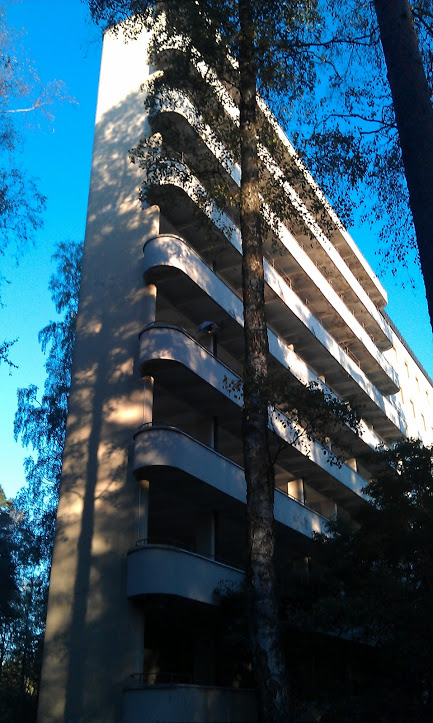
I scooped up the material for the first lesson in my new series, “Easy Finnish,” from the lawn as I was walking my trilingual dog Cholmondeley amid the famous tower blocks of Linnala, in ancient Imatra’s stuck-in-the-seventies Mansikkala neighorhood.
Apparently, the local smokers not only want to kill themselves. They also want to kill us with their trash, at least in the formerly picturesque Linnala.
I say “formerly,” because Linnala/Mansikkala will soon have more commercial retail space in terms of square meters per capita than any other similar neighborhood in Finland, for sure. More about that, below and later. Now we have to try and learn some Finnish.
Finnish: “Smoking is life-threatening.” Swedish: “Smoking can kill.”
The Finnish speakers are told that smoking (tupakointi) is life-threatening (hengenvaarallinen; the word is in the partitive case here). It sounds all very official and thus not to be taken too seriously.
Swedish speakers, on the contrary, are starkly told, “Smoking can kill.”
The language pulls no punches. Even a foreigner like me, whose grandfather’s native tongue was Swedish, but who has never had a single Swedish lesson in his life, gets the message.
All Finlanders, Fennophones and Swedophones alike, study both languages at school. In reality, the eastern part of the country, where Cholmondeley and I dwell part of the year, is utterly devoid of actual Swedophones.
A friend of mine once told me he tried to read a few Swedish-language novels a year to keep his school Swedish up. A couple of years ago, however, some of his neighbors launched a so-called people’s initiative to make the teaching of Swedish non-obligatory in Eastern Finnish schools. Fortunately, in March 2015, the Eduskunta, the country’s parliamentary, had the wisdom to smack down that stab at destroying the country’s identity.
Unfortunately, at the same time, they voted up an initiative that would permit kids living in the east of the country to study Russian instead of Swedish at school.
This nice-sounding but ultimately empty gesture was part and parcel of the same consumerist-driven Russophilia that, fueled by the relative prosperity of Petersburgers and Muscovites a few years ago (before Putin’s desire to become Master of the Universe and a big drop in the oil price tanked the Russian economy), caused the big towns of South Karelia, Lappeenranta and Imatra, to start reshaping themselves, often in stupid and destructive ways, to accommodate the Russian tourist-shopping boom. Now, just a few years later, the boom has almost completely dried up.
In any case, judging by what I have read in the press, none of this commercial frenzy has had any effect whatsoever on what foreign languages Finnish kids want to study, whether they live in the allegedly Russophilic east or the Russo-indifferent west. They still want to study languages that will have some utility for them as citizens of a European Union country and a globalizing world—German, French, and, above all, English.
Finnish legislators, on the contrary, apparently think the brightest dream the young people of South and North Karelia harbor for their lives is working in the tax-free checkout line at K Market, S Market or Lidl, where they can employ their high-school Russian to best effect.
Until recently, at least, you would see lots of empty Russian cigarette packs littering the yards, byways, beaches, and woods of Imatra, which is situated smack on the Russian-Finnish frontier, and is home to one of the country’s busiest border crossings.
These packs were probably not tossed on the ground by environmentally unfriendly Russian tourists and shoppers (although they would think nothing of doing just that in their own heavily polluted homeland), but by Imatrans themselves, unbelievably, especially since ten or so years ago you would have look hard to find any litter on the ground in this now-tarnished little gem of a town.
For the past several years, however, the locals have been taking advantage of the relative cheapness, in neighboring Russia, of certain vital goods like petrol, fags, and booze to dash across the border to Svetogorsk (the former Finnish town of Enso) to fill up their tanks and load up on cigarettes and hard alcohol.
But a new rule has come into effect (I forget which side instituted it) that obliges Finns to spend at least 24 hours on the Russian side of the frontier to be able to bring back three cartons of cigarettes.
That might put the kibosh on the once-routine petrol-and-cigarettes runs to Svetogorsk, but it might also ramp up the clandestine cross-border trade in some of those goods, which has been booming in parallel with legal commerce these past ten years.
In any case, the Swedophones have it right: smoking can kill.
Onko säälittävämpää näkyä
kuin kahdella sormella koneella kirjoittava aikuinen mies.
On kuin näkisi itsensä kadulla kävelemässä
takaapäin toisen kerroksen ikkunasta,
paljaan päälakensa, kyyryt hartiansa,
nöyryytyksensä taakan.
Is there a sight more pathetic
than a grown man writing with two fingers on a typewriter.
It’s like seeing oneself walking down the street
from behind out a second-floor window,
the pate of one’s bare head, one’s stooped shoulders,
the burden of one’s humiliation.
—Hannu Salakka, Yöllä näin kaiken vapaan maan (Otava, 1990)
Runolaituri (Poetry Platform), Jäppilä Point Road, Imatra, South Karelia
Our dead speak to us through our senses
as the marsh respires
reeks and squelches
bubbles and blooms
proffers its berries
and carries the bear.
Like the wind passing over the marsh
Lulling the cottonsedge as far as the eye can see
So our dead are present
underwater
in our soul’s
depths
drowned plants are swaying.
Our dead are rooted in us
they rest in us
our soul is heavy with drowned snags
and perhaps fruitful
perhaps in its cavities something forms a chain
and something invisible to us
surreptitiously proffers its purpose
which
(what relief)
is none of our business.
The merciless of human beings towards the natural environment, the built environment, and each other is going to catch up with them soon, I’m afraid.
The latest victim is a handsome apartment block in Imatrankoski, Imatra, built before the war (if I’m not mistaken) by Jalmari Lankinen, the then-head architect of Finland’s thriving second city, Viipuri (Vyborg).
Einonkatu 6 in Imatra bites the dust. April 26, 2016. Photo courtesy of Inka Nordlund and Uutisvuoksi.
I still haven’t figured out why this building had to go, even though I’ve read several incoherent explanations by city planners and developers in the local daily rag over the past year.
Most everywhere in the world, city planning and the construction business are rackets and mafias, and the real reason they knock things down is just to build something else in their place, almost always uglier, taller, needlessly expensive, and much less functional.
Lankinen is one of the most victimized architects from the glorious heyday of funkis (Finnish functionalism). Out in a gorgeous spot on the Lake Saimaa shore called Tiuruniemi, which is technically part of Greater Lappeenranta but is geographically part of Greater Imatra, Lankinen built an absolutely lovely tuberculosis hospital right before the Winter War, which then served as field hospital once the war started.
Tiuru Hospital. Photo by Living in FIN
Not so long ago, Tiuru Hospital served as the asylum seeker and refugee reception center for this part of Finland, but when developers decided to turn the nearby Rauha psychiatric asylum (another place with lots of good architecture, including some fine exemplars of funkis) into Holiday Club Saimaa, a retreat for bourgeois Russians flush with cash from the “prosperity” of the era of Putin 2.0, the asylum seekers were moved to a recently closed prison south of Joutseno, out of sight and mostly out of mind.
Holiday Club Saimaa and the Lappeenranta authorities had some vague plans to do something with Tiuru Hospital, but when the Russian and Finnish economies tanked, those plans came to naught, and the hospital has been sitting unoccupied in the woods for many years now. Recently, the Lappeenranta authorities made the Solomonic decision to stop heating the building, allegedly, because it was costing them too much. So now its degradation will proceed apace, although it is a listed building, supposedly protected by the Museovirasto or some such government agency.
When the refugee crisis struck, it occurred to me it would be a perfect opportunity to fix up Tiuru Hospital and fill it with life again, but inexplicably the Finnish Red Cross and the immigration authorities chose a hotel in Imatra that had fallen on hard times to accommodate its tiny quota of refugees.
Actually, there are so many empty spaces in Imatra and other parts of South Karelia, you could probably easily house all the inhabitants of a small Syrian city here without anyone noticing.
But instead we get absolutely meaningless “renovation” and “urban renewal,” as pictured above, instead of an exciting experiment in learning to live together with perfect strangers and redefining Finnishness (and Europeanness).
This photo, of tiny Linnalankatu in Imatra, South Karelia, will not be featured in the show at the Hermitage. One of the qualities that Finnish modernist architecture has been praised for is its sensitivity to nature and the natural environment in its interactions with the built environment. Many of the masterpieces by, say, Alvar Aalto are praised for just this extreme sensitivity.
Oddly enough, one of Aalto’s great masterpieces, the Church of the Three Crosses, is located in Vuoksenniska, Imatra’s northernmost district. It was built in the 1950s, the same decade that saw Aalto drafting a master development plan for Imatra, which was then only a kauppala (market town), not a full-fledged kaupunkki or city.
Aalto’s plan featured a polycentric conception of the burgeoning market town with ambitions of becoming a city, with Imatrankoski (long a tourist center because of its famous rapids), Mansikkala (then mostly an apple in the eyes of city planners), and Vuoksenniska, all of them at a fair but reasonable distance from each other, each serving as an equal but distinct city center around which smaller residential neighborhoods would grow, with certain functions (such as administration and culture, in Mansikkala) focused in one particular center, while other functions, such as commerce, overlapping in all three centers.
Aalto counted on Imatra growing into a mighty city with a population of one hundred thousand by the 1980s. As it was, during its heyday in the eighties, the town had something like thirty-two thousand residents, while today that number has shrunk to below twenty-eight thousand.
It is hard to know what Aalto would have made of the famous housing estate that dominates Mansikkala, consisting of two types of identical high-rise buildings (there are four of each type), but for this kind of bare-bones modernist housing to work it has to be lushly interlarded with and surrounded by trees, meadows, shrubs, and other kinds of greenery.
When you build an estate like this and you’re not Alvar Aalto you cannot afford the luxury of not knocking down trees during construction, as Aalto famously did when building the Church of the Three Crosses. (Infamously, all those beautiful trees Aalto spared were blown down during a terrible storm a couple of years later.) In any case, old photos I have seen of the area back then show that Mansikkala was mostly fields and farmhouses.
So it has taken around forty years for the estate to become the lush, homey, quiet piece of semi-paradise its builders and first residents (many of them building co-op members, many of them still alive albeit in their late seventies or eighties) hoped it would be when they planted trees, shrubs, and grass around the comfortable but rather stark new residential buildings in Imatra’s new center, Mansikkala.
You are probably wondering right about now where all that lush greenery is in the photograph, above. Well, up until two years ago, the entire foreground and right side of the view you see was occupied precisely by trees, shrubs, and a largish meadow.
But it had to give way to a new big box store, the city’s biggest, in a neighborhood that already featured three large supermarkets and a big discount store. The new city planners and fathers, however, seeing the “neighbors from the east” coming over the border in increasing numbers a few years back, decided to throw caution to wind and let the powerful S Group rip up all that greenery and install a Prisma hypermarket in its place.
The irony was that S Group already had a Prisma store literally right across the street from where the new colossus to shopping-as-our-only-salvation now stands.
To make a long story (whose other parts I will probably tell later) short, the bottom dropped out of the Russian cross-border shopping market, predictably, and now the Prisma hypermarket looks set to destroy its competitors not only in Mansikkala but in the other two central districts of the city as well, because its original purpose, to satisfy ever-increasing numbers of whimsical and wasteful Russians, has disappeared, so it has to have some other purpose, even one it might not have wanted originally. Because what city of twenty-seven thousand people needs the retail capacity of a city of one hundred thousand, as Imatra has now?
Unknown Artist, Portrait of Alexander Stubb on a Finnish Welfare Application Form. Photographed in the painting department at Saimaa University of Applied Sciences (Saimaan AMK), Imatra, September 19, 2015, during Kaakon Taiderastit, an open-house studio and art space crawl held in South Karelia and the Kymi Valley on September 12 and September 19. Photo by Living in FIN










 Living in FIN