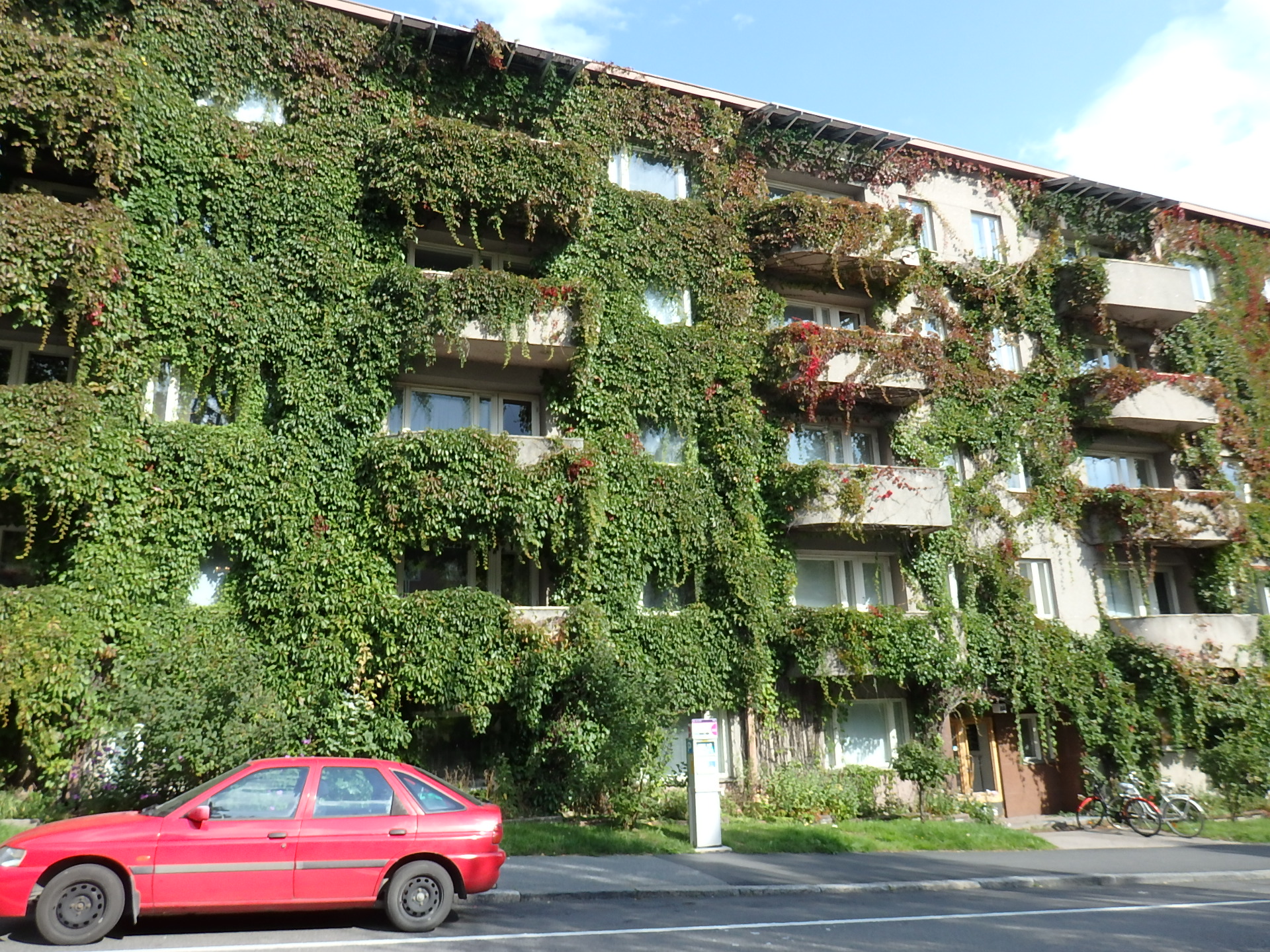
The past two days, I was in Jyväskylä, where I spotted this excellent example of funkis covered with ivy in the downtown.
It reminded me, for some reason, about the old song in which “little lambs” are said, unaccountably, to “eat ivy.”
You know the song.
Maybe jvyäskyläisiä don’t know the song, but they probably don’t need to, seeing as how they live in a town so rich in manmade and natural beauty, and can keep themselves busy with that.
I will be posting more about what I saw there in the coming days.
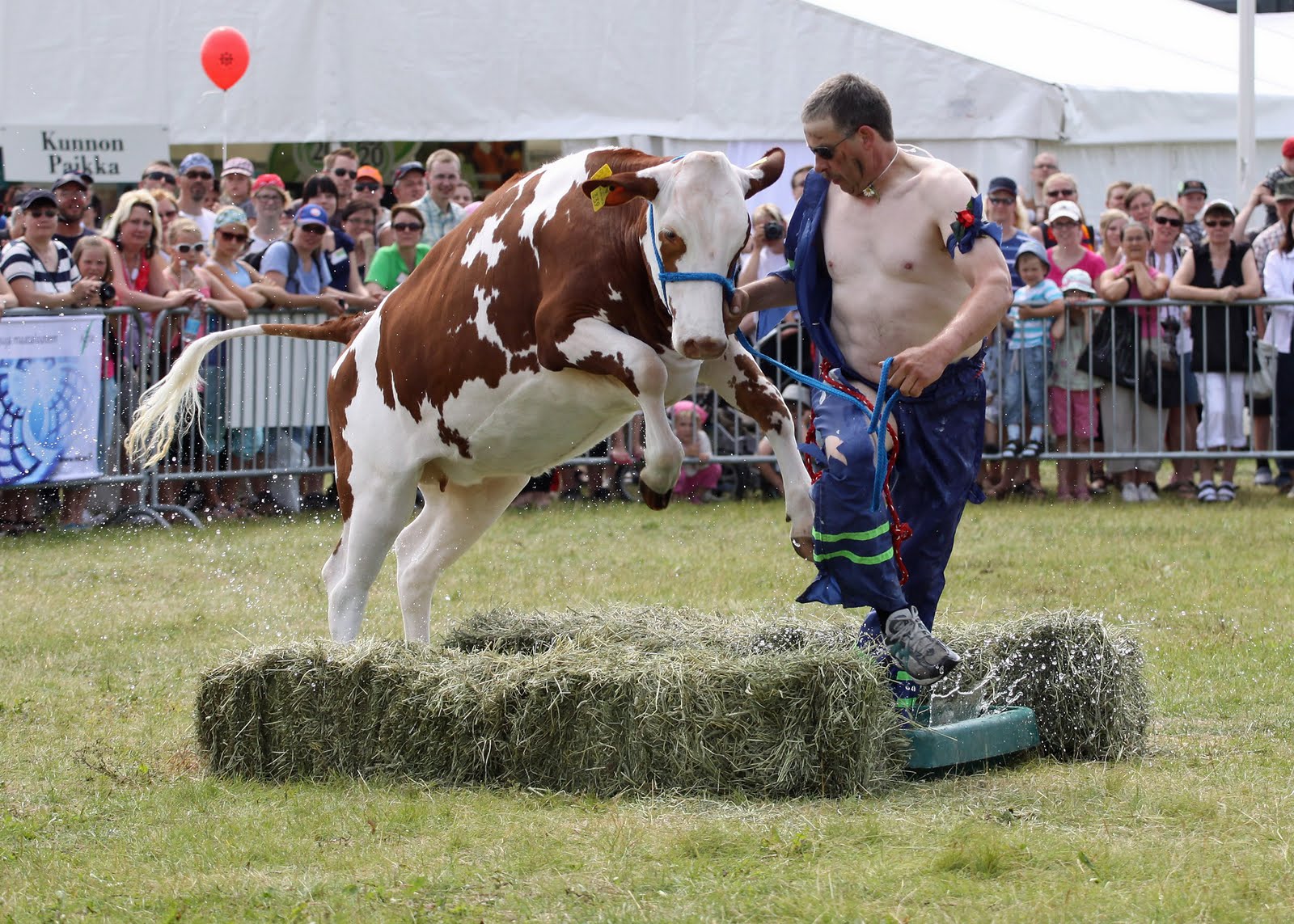
I was just reading in yesterday’s edition of Etelä-Saimaa newspaper about a show of cows (lehmiä) and hiehoja at the Kouvola Regional Vocational College’s Natural Resources Center in the town of Anjala. Since I didn’t know what the word hieho meant, I googled it. This was the first entry that came up.
Hieho on kultaa hieho on hopeaa hieho on pronssia hieho on nopea Nivelet maistuu voissa ne paistuu nivelet maistuu voissa ne paistuu Hieho! Hieho!
Jne.
The heifer is gold the heifer is silver the heifer is bronze the heifer is fast Joints taste like they are fried in butter Joints taste like they are fried in butter Heifer! Heifer
Etc.
South Karelians should have no trouble identifying where Wöyh! filmed this fabulous video.
And I will never forget what hieho means ever again.
Kuolevat syöttävät lintuja.
Siksi sanotaan että linnut tietävät kuolemaa.
Eläimet ymmärretään aina väärin.
Ajat ovat sellaiset että olisi sanottava joka hetki
jotain lopullista.
Olla niin lähellä maata
että kuulee mitä se sanoo,
tulla osaksi sen ääntä,
olla sen tahtoa ja tajuntaa,
palata siihen mitä on aina tiennyt.
Se on itsestään selvää
mutta ei yksinkertaista.
Moninaisuuden voi tajuta vain
koko olemuksellaan
eikä sen tajuamisesta enää halua pois.
The dying feed the birds.
So it is said birds presage death.
Animals are always misunderstood.
The times are such one should say something final
every instant.
Be so close to the earth
one hears what it says,
become a part of its voice,
be its will and consciousness,
go back to what has always been known.
That is self-evident
but not simple.
The manifold can be grasped only
by its entire essence
not by wanting to avoid grasping it anymore.
Onko säälittävämpää näkyä
kuin kahdella sormella koneella kirjoittava aikuinen mies.
On kuin näkisi itsensä kadulla kävelemässä
takaapäin toisen kerroksen ikkunasta,
paljaan päälakensa, kyyryt hartiansa,
nöyryytyksensä taakan.
Is there a sight more pathetic
than a grown man writing with two fingers on a typewriter.
It’s like seeing oneself walking down the street
from behind out a second-floor window,
the pate of one’s bare head, one’s stooped shoulders,
the burden of one’s humiliation.
—Hannu Salakka, Yöllä näin kaiken vapaan maan (Otava, 1990)
Runolaituri (Poetry Platform), Jäppilä Point Road, Imatra, South Karelia
Our dead speak to us through our senses
as the marsh respires
reeks and squelches
bubbles and blooms
proffers its berries
and carries the bear.
Like the wind passing over the marsh
Lulling the cottonsedge as far as the eye can see
So our dead are present
underwater
in our soul’s
depths
drowned plants are swaying.
Our dead are rooted in us
they rest in us
our soul is heavy with drowned snags
and perhaps fruitful
perhaps in its cavities something forms a chain
and something invisible to us
surreptitiously proffers its purpose
which
(what relief)
is none of our business.
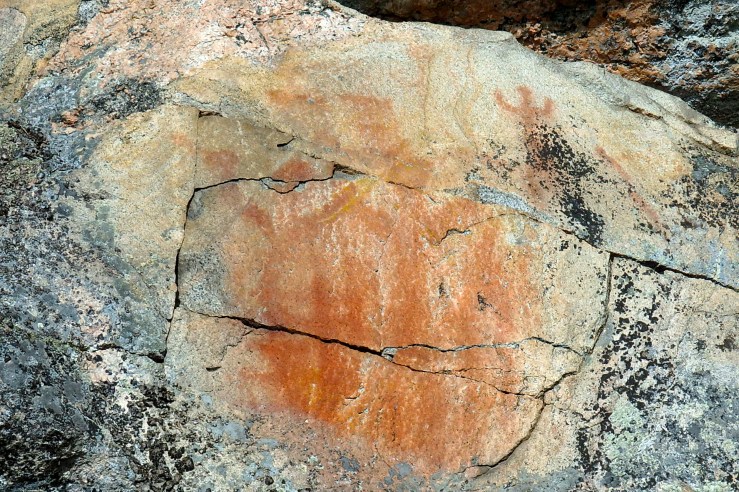
During the Stone Age, Finnish contemporary art looked something like this.
And it was exhibited in site-specific installations such as this.
Since the Stone Age, Finnish contemporary art has gone downhill. Like everything else in Finland. And like everywhere else.
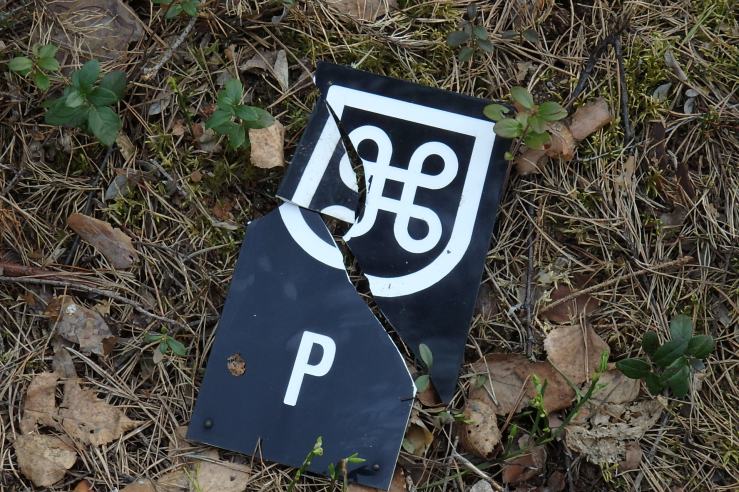
The Kolmiköytisienvuori rock painting is located in Ruokolahti commune in the eastern part of the southern Lake Saimaa region. The painting consists of a single densely painted area on a rock outcropping that is visible far out into the lake. The painting has been dated to the early New Stone Age. The site is signposted before the turn on the road from Savilahti to Sapola on Äitsaari Island.
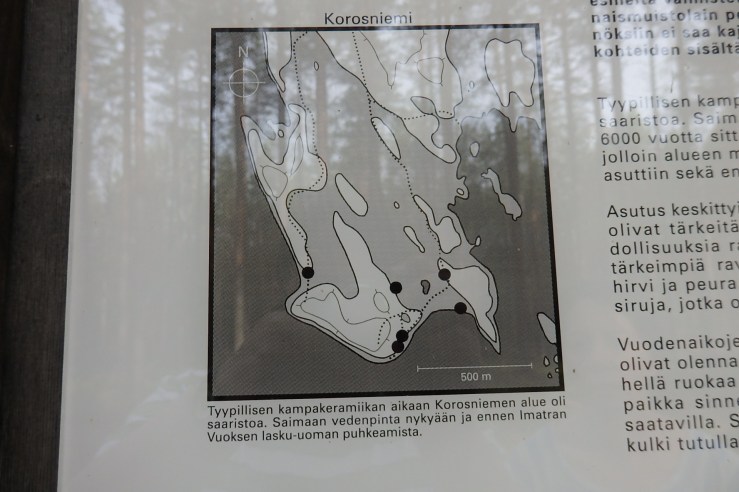
The painting was discovered in 1977 by Timo Miettinen, who is also listed as the painting’s inventory curator. Miettinen inventoried the painting in 1994, and Minna Kähtävä-Marttinen, in 1996. About two kilometers to the west of Kolmiköytyisienvuori, a typical Comb Ware period dwelling site has been found on Korosniemi Cape. Based on its location and height, the rock painting has been dated to around 3,000 BCE.
The merciless of human beings towards the natural environment, the built environment, and each other is going to catch up with them soon, I’m afraid.
The latest victim is a handsome apartment block in Imatrankoski, Imatra, built before the war (if I’m not mistaken) by Jalmari Lankinen, the then-head architect of Finland’s thriving second city, Viipuri (Vyborg).
Einonkatu 6 in Imatra bites the dust. April 26, 2016. Photo courtesy of Inka Nordlund and Uutisvuoksi.
I still haven’t figured out why this building had to go, even though I’ve read several incoherent explanations by city planners and developers in the local daily rag over the past year.
Most everywhere in the world, city planning and the construction business are rackets and mafias, and the real reason they knock things down is just to build something else in their place, almost always uglier, taller, needlessly expensive, and much less functional.
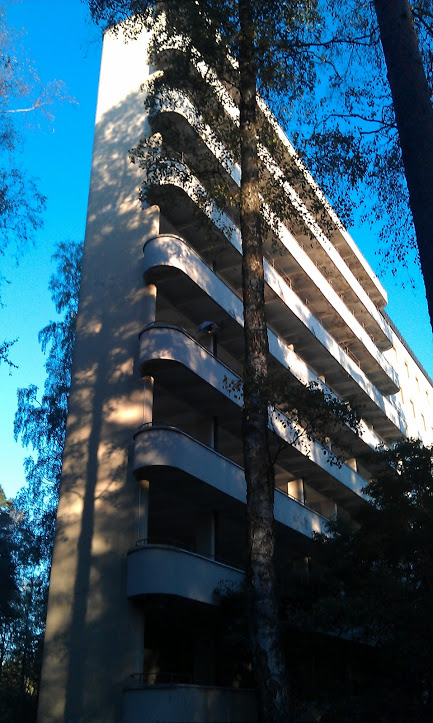
Lankinen is one of the most victimized architects from the glorious heyday of funkis (Finnish functionalism). Out in a gorgeous spot on the Lake Saimaa shore called Tiuruniemi, which is technically part of Greater Lappeenranta but is geographically part of Greater Imatra, Lankinen built an absolutely lovely tuberculosis hospital right before the Winter War, which then served as field hospital once the war started.
Tiuru Hospital. Photo by Living in FIN
Not so long ago, Tiuru Hospital served as the asylum seeker and refugee reception center for this part of Finland, but when developers decided to turn the nearby Rauha psychiatric asylum (another place with lots of good architecture, including some fine exemplars of funkis) into Holiday Club Saimaa, a retreat for bourgeois Russians flush with cash from the “prosperity” of the era of Putin 2.0, the asylum seekers were moved to a recently closed prison south of Joutseno, out of sight and mostly out of mind.
Holiday Club Saimaa and the Lappeenranta authorities had some vague plans to do something with Tiuru Hospital, but when the Russian and Finnish economies tanked, those plans came to naught, and the hospital has been sitting unoccupied in the woods for many years now. Recently, the Lappeenranta authorities made the Solomonic decision to stop heating the building, allegedly, because it was costing them too much. So now its degradation will proceed apace, although it is a listed building, supposedly protected by the Museovirasto or some such government agency.
When the refugee crisis struck, it occurred to me it would be a perfect opportunity to fix up Tiuru Hospital and fill it with life again, but inexplicably the Finnish Red Cross and the immigration authorities chose a hotel in Imatra that had fallen on hard times to accommodate its tiny quota of refugees.
Actually, there are so many empty spaces in Imatra and other parts of South Karelia, you could probably easily house all the inhabitants of a small Syrian city here without anyone noticing.
But instead we get absolutely meaningless “renovation” and “urban renewal,” as pictured above, instead of an exciting experiment in learning to live together with perfect strangers and redefining Finnishness (and Europeanness).

 Kuokkala Bridge, Ainolanranta, Jyväskylä, September 2, 2016






 Living in FIN