Suomalainen
Suomalainen on sellainen joka vastaa kun ei kysytä,
kysyy kun ei vastata, ei vastaa kun kysytään,
sellainen joka eksyy tieltä, huutaa rannalla
ja vastarannalla huutaa toinen samanlainen:
metsä raikuu, kaikuu, hongat humajavat.
Tuolta tulee suomalainen ja ähkyy, on tässä ja ähkyy,
Tuonne menee ja ähkyy, on kuin löylyssä ja ähkyy
Kun toinen heittää kiukalle vettä.
Sellaisella suomalaisella on aina kaveri,
Koskaan se ei ole yksin ja se kaveri on suomalainen.
Eikä suomalaista erota suomalaisesta mikään,
ei mikään paitsi kuolema ja poliisi
—Jorma Etto, Ajastaikaa (WSOY, 1964)
A Finn
A Finn is the kind of person who answers when she isn’t asked,
asks when he isn’t answered, and doesn’t answer when asked.
The kind of person who loses her way, hollers on the shore,
and another like him hollers from the opposite shore.
The forest resounds, echoes, the big pines drone.
The Finn comes from over yonder, groaning, and here she is, groaning.
He goes over yonder, groaning, and groans as if she is in the sauna
When another person tosses water on the stove.
A Finn like this always has a pal.
She is never alone, and that pal is a Finn.
Nothing separates Finn from Finn,
Nothing except death and the police.
* * * * * *
Jorma Etto’s poem “A Finn” rose to national prominence when President Urhu Kekkonen quoted it during a New Year’s speech in the 1970s. When asked by journalist Maarit Tyrrkö what a Finn was, during a tape-recorded interview in 1976, Kekkonen also quoted the poem, albeit omitting lines six through eight accidentally or intentionally.
I have taken perhaps unwanted license with the sex of the collective singular Finn sketched in the poem, because the Finnish language has complete gender neutrality and, thus, utter ambiguity, when it comes to grammar, if not always (or, hardly ever) in real life. If you would like a more conventional albeit decidedly masculine rendering of Etto’s classic poem, see Keith Bosley’s excellent translation.
Photo and translation by Living in FIN. Video courtesy of Apumagazine.
“Urbaani nainen imettää, missä halua.” (“The urban woman breastfeeds where she wishes.”)
—Headline in the February 25–26, 2017, edition of Iltalehti newspaper
Minä syön kaurapuuroa ja ruisleipää sen kanssa.
Lapsuus nousee mieleen. Uunipuurot. Kiisselit.
Aamiaisaika oli silloin kello yhdentoista maissa.
Se mitä nyt sanotaan aamiaiseksi oli aamukahvi
tai aamupuuro. Se oli “syö ennen lähtöäsi”.
Tai “aamuplöröt”.* Tai “mie haukkaan ens vähän jottain”.
Tai “elä lähe tyhjin vatsoin”.
Tai “kuhan on märkää ja lämmintä”.
Unessani olivat isä ja äiti nuoria
ja minä imetin lasta.
I’m eating oatmeal with rye bread.
Childhood comes to mind. Baked porridges. Kissels.
Breakfast time was around eleven o’clock then.
What they call breakfast nowadays was morning coffee
or morning porridge. It was “eat before you leave.”
Or “morning coffee with a shot.”* Or “I’ll have a bite of something first.”
Or “don’t leave on an empty belly.”
Or “get it while it’s moist and warm.”
In my dream, mother and father were young,
and I was breastfeeding a child.
—Eeva Kilpi, Kiitos eilisestä (WSOY, 1996)
* Plörö. A mixture of coffee and spirits, traditionally enjoyed as follows: 1. Place a coin on the bottom of the cup. 2. Pour coffee into the cup until the coin is no longer visible. 3. Pour liquor into the coffee until the coin is visible again. 4. Drink and enjoy! 5. Repeat or, alternately, remove the coin to a safer place.
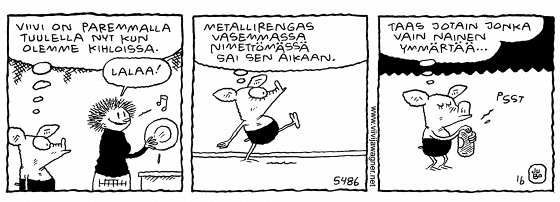
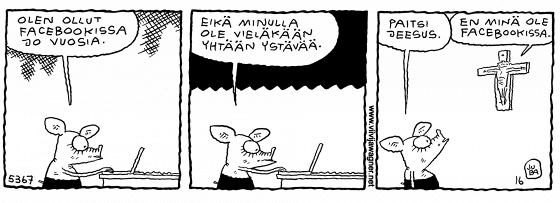
Living proof that Finnish is one of the world’s easiest languages is provided daily by the comic strip Fingerpori, written and drawn by Pertti Jarla since 2007 and syndicated in nearly all the daily Finnish newspapers I have ever read. If I am not mistaken, a few years back, Fingerpori overtook Viivi ja Wagner, which I have translated here on a few occasions, as the most popular comic strip in Finland.
Fingerpori‘s value for the Finnish learner is that nearly every strip is based on wordplay, double entendres, and the absurdity that arises when the characters take certain expressions literally or forget (like many tyros like me often do) that words can have entirely disparate meanings in different contexts.
Unlike Viivi ja Wagner, whose humor is based on Wagner’s charmingly uncharming piggishness and Viivi’s clear-eyed yet affectionate exasperation with her boyfriend’s endless faults and abysmal male chauvinism, Fingerpori cannot usually be translated in a straightforward way.
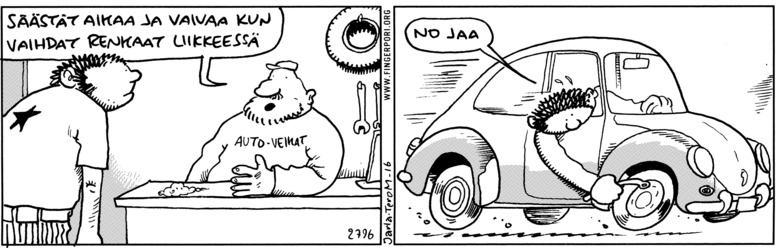
My fabulous former Finnish teacher Tiina has drawn my attention to this strip, in which the humor revolves around the word liike, whose basic meanings are “motion” and “movement,” on the one hand, and a “shop” or a “business,” on the other. Here it appears in the inessive case—liikkeessä. (Don’t ask me where the extra “k” and the extra “e” came from: it would take too long to explain.)
In the first panel, the auto mechanic advises the man on the left, “You will save time and trouble if you change [your] tires at a/the shop.”
Unfortunately, the man on the left has heard something else: “You will save time and trouble if you change [your] tires on the go.” Meaning, literally, while “in motion.”
In the second panel, we see the man trying mightily, indeed, to change his tires on the go.
“No jaa,” he says, probably in exasperation. “Oh well.”
I imagine it takes native Finnish speakers only a few milliseconds to get the joke. For Finnish learners, on the other hand, it is a test of our fluency or, at least, our ability to puzzle out things we don’t get right off the bat.
Finnish really is one of the world’s easiest languages.
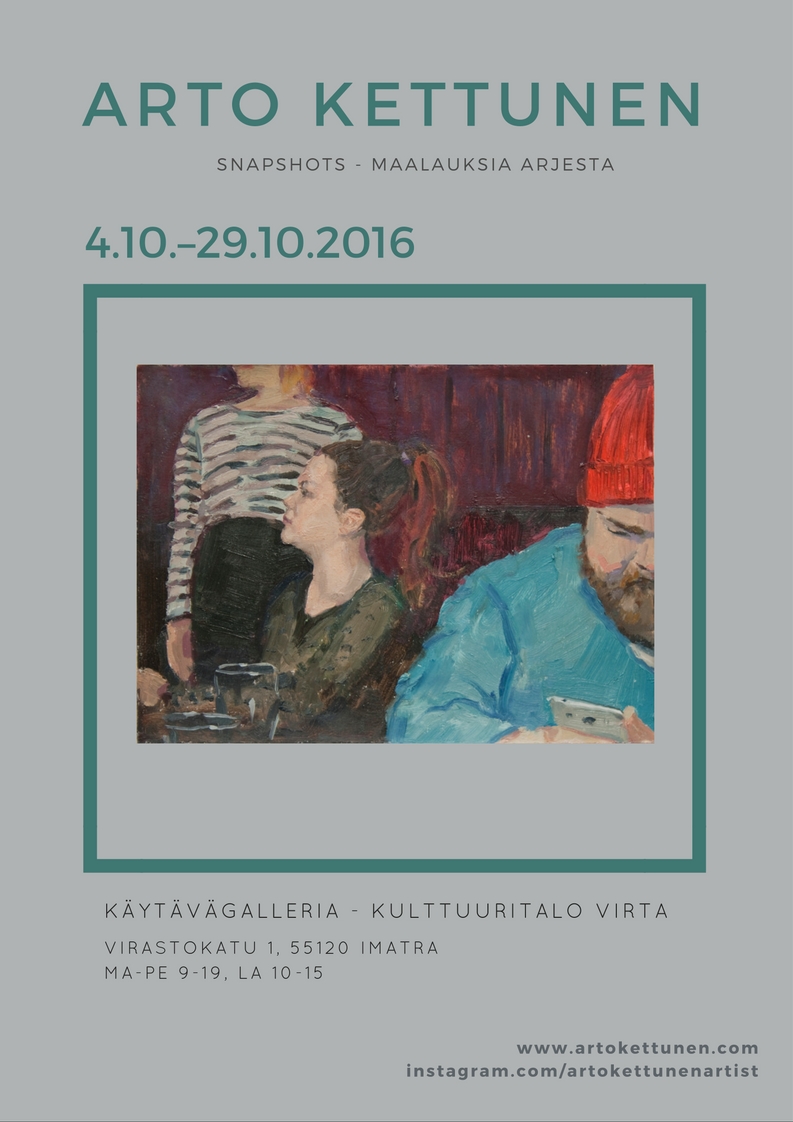
I was reminded of this again earlier today while taking in Snapshots, a fine show of recent paintings by young local artist Arto Kettunen, in the Käytävägalleria (“Corridor Gallery”) at Imatra’s cultural center, Kulttuuritalo Virta (“Stream House of Culture,” so called because it is situated alongside the once-raging Vuoksi River, dammed up on both ends during its now-short course in Finland—the rest of its length was lost to the Soviet Union during the Winter War (Talvisota) and Continuation War (Jatkosota)—to generate electricity).
Arto Kettunen, Sara ottaa selfien, 2016. Oil, 37 cm x 27 cm.
Sara ottaa selfien means, unsurprisingly, “Sara takes a selfie,” by analogy with the common expression ottaa valokuva, “(to) take a picture.”
Mr. Kettunen’s show runs until October 29. Be there or be square.
Another linguistic point of interest is that the show is entitled Maalauksia arjesta in Finnish—not “Snapshots” per se, but “Paintings from [or, about] Everyday Life.”
Arki is the nominative case of the word, which means, alternately, “weekday” or the ordinary, mundane days in life, the everyday. Given its mundaneness, you hear the word constantly in daily life—for example, in advertisements for daily specials at grocery stores.
The non-Finnish part of me (which is all of me, since I’m not Finnish) would like to wax poetic about the supreme importance of everyday life to Finns and Finnish culture (as opposed, say, to ruling the world), and how that makes Finland such a lovely, safe place to live most of the time, but I lack the words, even in English, to describe its complex simplicity.
In real life, I’m a fairly experienced professional translator from Russian to English.
In my virtual life, I’m a hapless tyro still trying to get a handle on the orderly but utterly alien beauty of Finnish.
I’m only happy to say that, after studying the language for five or six years more or less seriously, some things are starting to feel less alien.
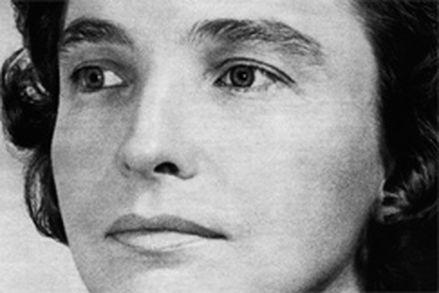
Then there are the dumb things you do when you’re “young”—in a language, not in life. I’ve fallen in love with an 88-year-old Finnish writer whom I’ve never met in real life and probably never will meet.
Her name is Eeva Kilpi. In Finland and other parts of the world, she is quite famous. She has even been rumored to be on the long list or shortlist (I don’t really know) for the Nobel Prize in Literature.
In English, however, she is virtually unknown. The first selection of her poems in English translation, wonderfully translated by Donald Adamson, A Landscape Blooms within Me, was published only two years ago. I could not recommend it more highly, especially because, as a bilingual edition, the book is a real boon to Finnish language learners like me.
If you’re one of the eight or nine humanoids who have been following this blog, you will have noticed I’ve been making way too much space lately for my own dubious translations of Eeva Kilpi’s poems.
So I can think of no better way of celebrating International Translation Day than pumping up the old random number generator to pick me a page number and, thus, a poem from Kilpi’s collected poems, Perhonen ylittää tien (A Butterfly Crosses the Road, WSOY, 2000), to translate for the occasion.
Chance operations took mercy on me today. They directed me to page seventy-one.
Vain kirjeen alussa me tohdimme enää
nimittää toisiamme rakkaaksi ja hyväksi.
Only at the letter’s beginning do we still dare
To call each other darling and dear.
—Eeva Kilpi, Laulu rakkaudesta ja muita runoja (WSOY, 1972)
Translated by Living in FIN. This translation is dedicated to V., my comrade in life, translating, and Finnish. It also happens to be her name day today.
As Cholmondeley and I were rambling round town this afternoon, we came upon this excrescence.
What was the tagger who spat out this little bit of verbal vandalism trying to say? There is no such word as soumi in Finnish.
The name of the language spoken here is suomi. And the name of the country where suomi is spoken is also Suomi. Thus:
Suomessa puhutaan suomea.
“In Finland, Finnish is spoken.”
The only Soumi I could find via a quick search of the internets was the Cameroonian (?) recording artist(s) (?) who released this fabulous single, “Paracétamol,” early this year.
On the strength of this uplifting piece of patois poetry, I don’t think he or she or they deserve the putdown they got in Imatra. After all,
Imatra ei ole Afrikassa vaan Suomessa.
“Imatra is not in Africa, but in Finland.”
Africa is indeed a long ways away in more ways than one.
I scooped up the material for the first lesson in my new series, “Easy Finnish,” from the lawn as I was walking my trilingual dog Cholmondeley amid the famous tower blocks of Linnala, in ancient Imatra’s stuck-in-the-seventies Mansikkala neighorhood.
Apparently, the local smokers not only want to kill themselves. They also want to kill us with their trash, at least in the formerly picturesque Linnala.
I say “formerly,” because Linnala/Mansikkala will soon have more commercial retail space in terms of square meters per capita than any other similar neighborhood in Finland, for sure. More about that, below and later. Now we have to try and learn some Finnish.
Finnish: “Smoking is life-threatening.” Swedish: “Smoking can kill.”
The Finnish speakers are told that smoking (tupakointi) is life-threatening (hengenvaarallinen; the word is in the partitive case here). It sounds all very official and thus not to be taken too seriously.
Swedish speakers, on the contrary, are starkly told, “Smoking can kill.”
The language pulls no punches. Even a foreigner like me, whose grandfather’s native tongue was Swedish, but who has never had a single Swedish lesson in his life, gets the message.
All Finlanders, Fennophones and Swedophones alike, study both languages at school. In reality, the eastern part of the country, where Cholmondeley and I dwell part of the year, is utterly devoid of actual Swedophones.
A friend of mine once told me he tried to read a few Swedish-language novels a year to keep his school Swedish up. A couple of years ago, however, some of his neighbors launched a so-called people’s initiative to make the teaching of Swedish non-obligatory in Eastern Finnish schools. Fortunately, in March 2015, the Eduskunta, the country’s parliamentary, had the wisdom to smack down that stab at destroying the country’s identity.
Unfortunately, at the same time, they voted up an initiative that would permit kids living in the east of the country to study Russian instead of Swedish at school.
This nice-sounding but ultimately empty gesture was part and parcel of the same consumerist-driven Russophilia that, fueled by the relative prosperity of Petersburgers and Muscovites a few years ago (before Putin’s desire to become Master of the Universe and a big drop in the oil price tanked the Russian economy), caused the big towns of South Karelia, Lappeenranta and Imatra, to start reshaping themselves, often in stupid and destructive ways, to accommodate the Russian tourist-shopping boom. Now, just a few years later, the boom has almost completely dried up.
In any case, judging by what I have read in the press, none of this commercial frenzy has had any effect whatsoever on what foreign languages Finnish kids want to study, whether they live in the allegedly Russophilic east or the Russo-indifferent west. They still want to study languages that will have some utility for them as citizens of a European Union country and a globalizing world—German, French, and, above all, English.
Finnish legislators, on the contrary, apparently think the brightest dream the young people of South and North Karelia harbor for their lives is working in the tax-free checkout line at K Market, S Market or Lidl, where they can employ their high-school Russian to best effect.
Until recently, at least, you would see lots of empty Russian cigarette packs littering the yards, byways, beaches, and woods of Imatra, which is situated smack on the Russian-Finnish frontier, and is home to one of the country’s busiest border crossings.
These packs were probably not tossed on the ground by environmentally unfriendly Russian tourists and shoppers (although they would think nothing of doing just that in their own heavily polluted homeland), but by Imatrans themselves, unbelievably, especially since ten or so years ago you would have look hard to find any litter on the ground in this now-tarnished little gem of a town.
For the past several years, however, the locals have been taking advantage of the relative cheapness, in neighboring Russia, of certain vital goods like petrol, fags, and booze to dash across the border to Svetogorsk (the former Finnish town of Enso) to fill up their tanks and load up on cigarettes and hard alcohol.
But a new rule has come into effect (I forget which side instituted it) that obliges Finns to spend at least 24 hours on the Russian side of the frontier to be able to bring back three cartons of cigarettes.
That might put the kibosh on the once-routine petrol-and-cigarettes runs to Svetogorsk, but it might also ramp up the clandestine cross-border trade in some of those goods, which has been booming in parallel with legal commerce these past ten years.
In any case, the Swedophones have it right: smoking can kill.





 Living in FIN