Eeva Kilpi, “An Easter Prayer”

31 March

7:40 P.M., EASTER SUNDAY, 31 March 2002

An Easter Prayer

O gracious God,
give some meaning
to this existence!

Source: Eeva Kilpi, Elämää kaikki päivät [Life Every Day], WSOY, 2022. Translated by Living in FIN


A Beloved Poet’s Snapshots over Four Decades

How can one be old when one has only just learned to be young?

Life Every Day contains Eeva Kilpi’s diary entries from the 1980s to the 2000s. “One must appreciate the beauty of everyday language,” the author reminds herself as she tirelessly jots down her observations. She examines intergenerational relationships, aging and time, longing and loneliness, creativity and remembrance while never forgetting her overarching leitmotifs of peace and nature conservation: “One good deed for nature every day.”

The poet fearlessly confronts a changing world and engages in dialogue with it time and again:

“You are not alone, you are not alone,” the birds sing in the silence of the night, and I wish to accept this assurance from them alone.

Eeva Kilpi (b. 1928) is a writer and poet living in Espoo. Her widely translated works include novels, short story and poetry collections, and an autobiographical trilogy. One of Kilpi’s best-known works is Elämä edestakaisin (1964), in which she examines the lives of displaced persons. In addition to her depictions of persons displaced from Karelia, Kilpi is also known for her reflections on human relationships and nature. She has been a trailblazer in depicting sexuality and aging. She has been honored for her multifaceted and socially conscious body of work with awards such as the SKS Prize and the Pro Carelia Medal.

Source: Adlibris. Translated by Living in FIN

Pasha

In Finland, both Lutherans and Greek Catholics celebrate Easter on the same day, and this year that day was this past Sunday, April 1. But Russian Orthodox Easter will be celebrated this coming Sunday, April 8.

No Orthodox Easter meal, whether in Finland or Russia, would be complete without pasha (in Russian, пасха; the same word also denotes the holiday itself). To my mind, it is the most delicious sweet treat I have ever tasted, and it is all the better that purists, like my boon companion, make it only once a year for serving on Easter Day itself and finishing off in the days following Christianity’s most important feast day.

My sweetheart makes pasha the old-fashioned Russian way, which takes a few days. First, she makes Russian творог (quark, curd, cottage cheese, farmer cheese) from fresh milk before mixing the homemade curd with the other ingredients and pouring the thick liquidy mixture thus produced into traditional wooden molds, lined with gauze.

The molds are turned upside down and drained for 24 hours before being placed in the refrigerator to set up. On Easter Day, the molds and gauze lining their insides are carefully removed, revealing tiny pyramid-like mounds of pasha in all their delectable glory, impressed with the Cyrillic letters ХВ (standing for Христов воскрес! or “Christ has risen!”) on one side, and the Orthodox cross on the opposite side.

The recipe I have translated, below, is a quick, easy Finnish variation on its hardcore, time-consuming Russian cousin.

One year, my true love and I found ourselves celebrating Easter in Finland. We brought our wooden molds along with us, but we used a Finnish recipe much like this one, whose mainstay is the Finnish variety of quark/farmer cheese/curd/tvorog, known as rakha. Rakha can be bought readymade and packaged in any grocery store. As we discovered, it makes an excellent pasha, and is generally less watery than tvorog, homemade or bought at the market, meaning it drains and sets up more quickly, and is thus much less of a hassle to work with.

Make sure to watch the video, below the recipe, for a great tip on how to turn your pasha into a pyramid without using the Russian wooden molds.

Pasha

Ingredients

    • 100 g creamery butter
    • dl sugar
    • 2 packages (250 g each) quark
    • dl whipping cream (double cream)
    • egg
    • fresh-squeezed juice of half an orange
    • tsp vanilla sugar
    • 1/2 dl chopped almonds
    • 1/2 dl raisins
    • 1/2 dl succade (chopped bits of candied fruit)
Directions
  1. Whip the cream. Whip the butter and sugar until frothy. Add the quark, eggs, flavorings, and whipped cream. Pour the quark mixture into a gauze-lined pasha mold or colander to drain. You can also used a coffee filter lined with filter paper. Let the mixture drain in a cool place (i.e., a refrigerator) overnight.
  2. Flip the pasha over the next day onto a serving dish and garnish with slices of fresh fruit if desired. Serve as a dessert or at coffee time with other Easter goodies.

Source: K-ruoka.fi. Translated by Living in FIN


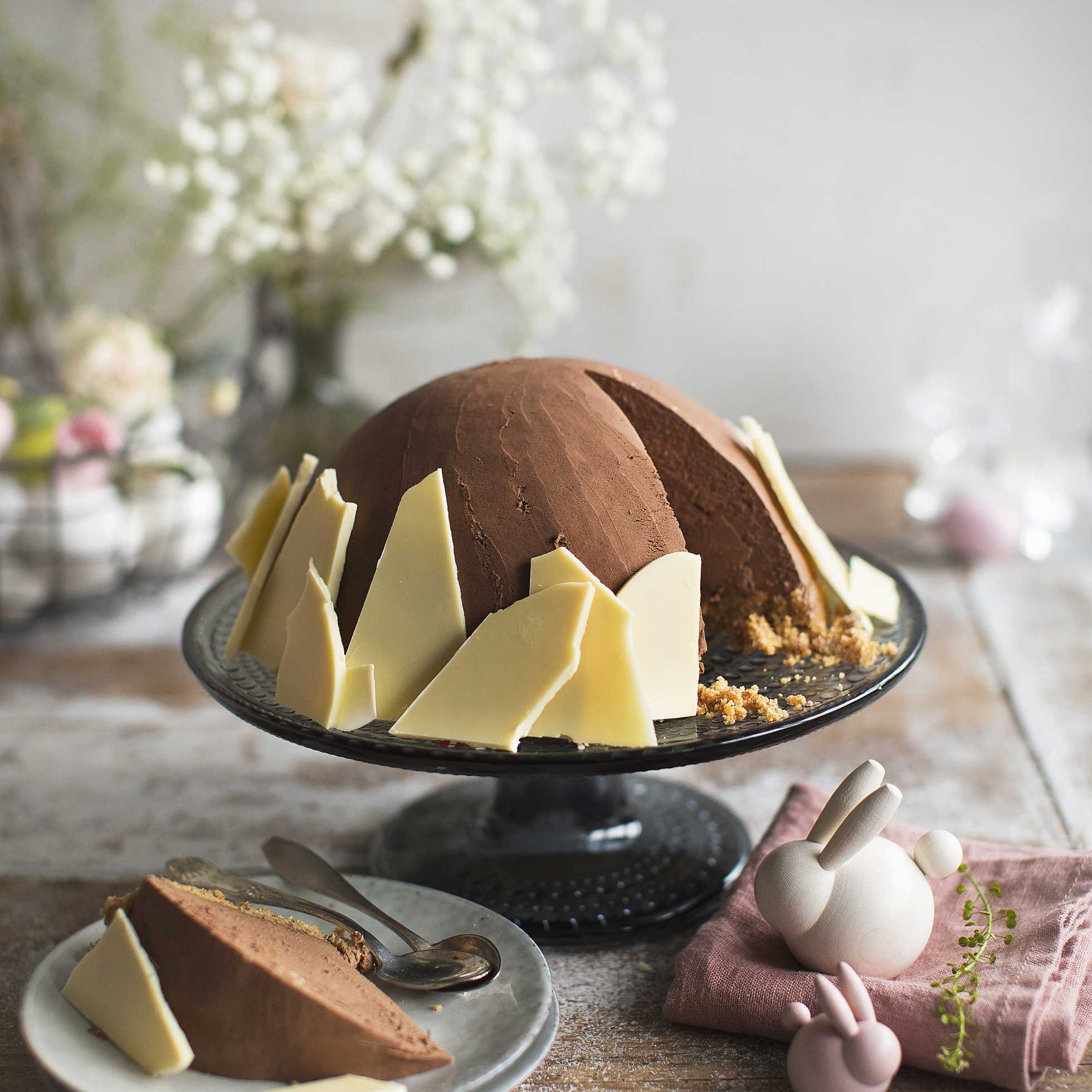
Mignon Chocolate Egg Cake

mignonkakku

Mignon Chocolate Egg Cake

Source: Meillä Kotona (Maku)
Text: Anni Pitkänen
Photos: Kreetta Järvenpää

Ingredients (16 servings)

Filling

  • 2 gelatin sheets
  • 2 ½ dl whipping cream
  • 200 g dark chocolate
  • 2 Fazer Mignon chocolate eggs (52 g each)
  • 200 g unflavored cream cheese (do not use light cream cheese)
  • ½ dl water
  • 2 tbsp dark cocoa powder

Crust

  • 100 g digestive biscuits
  • 1 ½ dl ground hazelnuts
  • 1 ½ dl ground almonds
  • 100 g water

Topping

  • 150 g white chocolate

Cooking Directions

Total prep time: 6 hours and 45 minutes (active prep time: 45 minutes)

Soak the gelatin sheets in cold water for at least 5 minutes. Whip the cream.

Chop the chocolate into bits and peel the Mignon eggs. Melt them carefully in a microwave a few seconds at a time. Mix the chocolate bits while melting them. Mix the chocolate mixture with the whipped cream.

Whisk the cream cheese in a large mixing bowl with an electric mixer until smooth. Add the chocolate-whipped cream mixture to the whisked cream cheese.

Heat the water in a saucepan. Remove the pan from the stove and add the cocoa powder.  Squeeze the excess water from the gelatin sheets and add them to the saucepan with the water-cocoa mixture. Pour the gelatin mixture into the filling in thin ribbons. Whisk the mixture quickly, just until the ingredients are are blended.

Pour the filling into a 1.5-liter round-bottomed bowl lined with cling wrap. Level off the surface. Put the filling in the refrigerator.

Crush the biscuits and measure the powdered hazelnuts and almonds into the mixture. Brown butter in a saucepan.  Heat the butter until it takes on a scorched brown color. Pour the browned butter into the mixture of crushed biscuits and powdered nut. Mix until smooth.

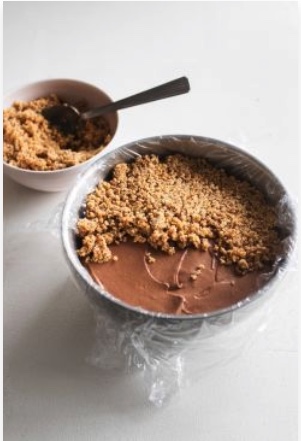
Once the mixture has cooled, use a spoon to pat it on top of the filling to form a bottom crust.  Let the cake cool in the fridge for at least 6 hours, preferrably overnight.

crust

Melt the white chocolate in the microwave a few seconds at a time. Mix the chocolate while melting it.

Spread the white chocolate on a piece of baking paper. Let it solidify in the refrigerator. Using a knife, cut the chocolate into differently shaped pieces and set them randomly around the edge of the cake.

Press the white chocolate pieces against the cake. When the cake is cut, each person gets a piece of the “eggshell.”

Translated by Thomas H. Campbell