The Death of Einonkatu 6

The merciless of human beings towards the natural environment, the built environment, and each other is going to catch up with them soon, I’m afraid.

The latest victim is a handsome apartment block in Imatrankoski, Imatra, built before the war (if I’m not mistaken) by Jalmari Lankinen, the then-head architect of Finland’s thriving second city, Viipuri (Vyborg).

Einonkatu 6
Einonkatu 6 in Imatra bites the dust. April 26, 2016. Photo courtesy of Inka Nordlund and Uutisvuoksi.

I still haven’t figured out why this building had to go, even though I’ve read several incoherent explanations by city planners and developers in the local daily rag over the past year.

Most everywhere in the world, city planning and the construction business are rackets and mafias, and the real reason they knock things down is just to build something else in their place, almost always uglier, taller, needlessly expensive, and much less functional.

Lankinen is one of the most victimized architects from the glorious heyday of funkis (Finnish functionalism). Out in a gorgeous spot on the Lake Saimaa shore called Tiuruniemi, which is technically part of Greater Lappeenranta but is geographically part of Greater Imatra, Lankinen built an absolutely lovely tuberculosis hospital right before the Winter War, which then served as field hospital once the war started.
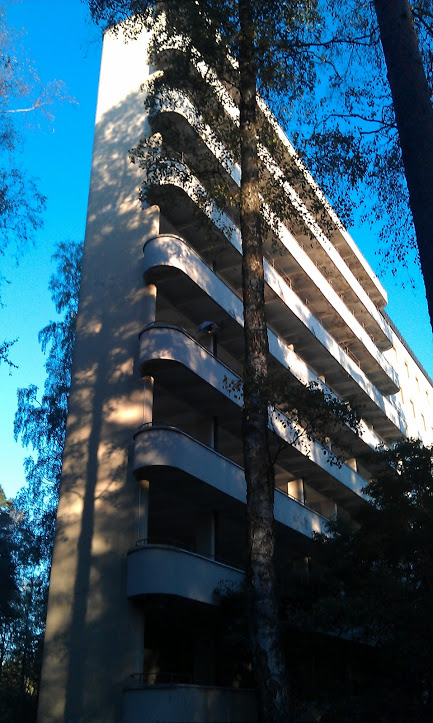
IMAG0164
Tiuru Hospital. Photo by Living in FIN

Not so long ago, Tiuru Hospital served as the asylum seeker and refugee reception center for this part of Finland, but when developers decided to turn the nearby Rauha psychiatric asylum (another place with lots of good architecture, including some fine exemplars of funkis) into Holiday Club Saimaa, a retreat for bourgeois Russians flush with cash from the “prosperity” of the era of Putin 2.0, the asylum seekers were moved to a recently closed prison south of Joutseno, out of sight and mostly out of mind.

Holiday Club Saimaa and the Lappeenranta authorities had some vague plans to do something with Tiuru Hospital, but when the Russian and Finnish economies tanked, those plans came to naught, and the hospital has been sitting unoccupied in the woods for many years now. Recently, the Lappeenranta authorities made the Solomonic decision to stop heating the building, allegedly, because it was costing them too much. So now its degradation will proceed apace, although it is a listed building, supposedly protected by the Museovirasto or some such government agency.

When the refugee crisis struck, it occurred to me it would be a perfect opportunity to fix up Tiuru Hospital and fill it with life again, but inexplicably the Finnish Red Cross and the immigration authorities chose a hotel in Imatra that had fallen on hard times to accommodate its tiny quota of refugees.

Actually, there are so many empty spaces in Imatra and other parts of South Karelia, you could probably easily house all the inhabitants of a small Syrian city here without anyone noticing.

But instead we get absolutely meaningless “renovation” and “urban renewal,” as pictured above, instead of an exciting experiment in learning to live together with perfect strangers and redefining Finnishness (and Europeanness).

Who needs it?
Living Suitcase

lenin-1

“In the manner of Arkady Rylov, Difficult Journey. Oil on Canvas. Pargas Local History Museum. [Vladimir Lenin] was one of the ‘living suitcases’ of Finnish smugglers. Lenin fled to Finland just before Christmas 1907 after an unsuccessful attempt to begin a revolution in Saint Petersburg. Before continuing to Sweden, he spent a couple of nights hiding in Parainen, in the Kirjala manor. He introduced himself as ‘Doktor Müller,’ a German geologist. The Pargas Local History Museum received this work for its Lenin memorial room in 1969 from the Finland-Soviet Peace and Friendship Society.” The painting is currently on view at the South Karelia Art Museum in Lappeenranta, Finland, as part of the exhibition Barefoot: 10 Lives in the Karelian Isthmus, which runs until January 2016. Photo by Comrade VZ. Quoted text, above, reproduced from the exhibition signage

lenin-3

lenin-4
“V.I. Lenin spoke at a conference of Russian social democrats in this building in August 1907.” Kotka Concert Hall, August 2015. Photo by Comrade VZ
lenin-5
“This building, designed by Eliel Saarinen, was completed in 1907. It was destroyed in a bombing raid on July 6, 1941, and rebuilt in 1954.” Kotka Concert Hall, August 2015. Photo by Comrade VZ
800px-Kotkan_konserttitalo_2
Kotka Concert Hall. Image courtesy of Wikipedia

Got the Matra Blues

OLYMPUS DIGITAL CAMERA

Imatra ranked at the tail end of Finnish municipalities in a happiness study by newspaper Helsingin Sanomat, in 243rd place. [Neighboring] Ruokalahti, on the contrary, did fairly well, coming in as Finland’s fifty-eighth happiest municipality. [Neighboring] Rautjärvi ended up in 199th place. At the moment there are a total of 317 municipalities in Finland, sixteen of which are in the [autonomous] Åland Islands.

[…]

In Imatra, use of anti-depression medications is slightly above the national average. Nine percent of residents take anti-depressants, while the average is 8.4 percent among Finnish municipalities. Child welfare clients among minors residing in Imatra is as much as ten percent, while the average is 6.5 percent among Finnish municipalities.

Also, the number of offenses committed while drunk or under the influence of drugs is relatively high. Two people per every thousand Imatrans are charged with having committed a crime while intoxicated, whereas the average in Finland is 1.2 person per thousand residents.

[…]

—Mari Lääperi, “Imatra Did Not Fare Well in Happiness Comparison,” Uutisvuoksi, September 1, 2015

Photo and translation by Living in FIN

Pentti Saarikoski: Trotsky Says

kuuluisassa vallankumouksen historiassaan Trotski kertoo
kun Leninillä
oli silmälasit ja tekotukka
kun Pietarissa satoi
äiti Venäjä synnytti lasta
josta oli tuleva

kun tarjoilu on loppunut
asiakkkaat hätistelty pois
tuolit nostettu pöytien päälle
ja kassa laskee rahoja
kun katsoo tätä ulkoa
ja kaikki on niin kuin tavallisesti
ja jatkuu ja on jatkunut

auto näyttää omaisuuden arvoiselta minä olen pelkkää
pimeyttä niinkuin enkeli
joka lentää omaa valoaan nopeammin

—Pentti Saarikoski, Mitä tapahtuu todella? (1962)

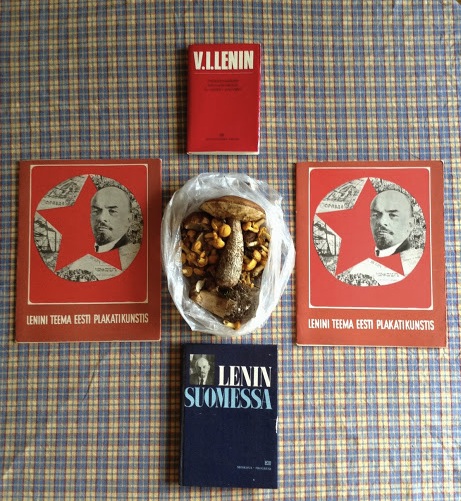
lenin grib

in his famous history of the Revolution Trotsky says
when Lenin
had glasses and a wig
when it was raining in Petersburg
Mother Russia gave birth to a child
from which the future emerged

when service is over
the customers shooed out
the chairs put on the tables
and the cashier is counting the money
when one looks at this from outside
and everything is as usual
and goes on and has been going on

the car looks like it is worth a fortune I am mere
darkness like an angel
who flies faster than its own light

Pentti Saarikoski, What Is Really Happening? (1962)

Translation and collage by Living In FIN