Panel 1
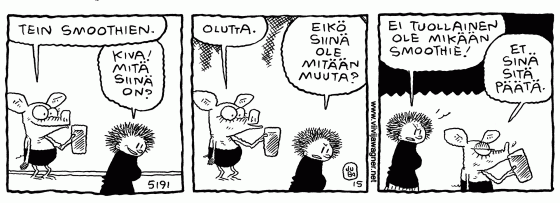
Wagner: I made a smoothie.
Viivi: Great! What’s in it?
Panel 2
Wagner: Some beer.
Viivi: Isn’t there anything else in it?
Panel 3
Viivi: There is no such smoothie!
Wagner: That is not for you to decide.
Translated by Living in FIN. Thanks to Comrade DE for the heads-up. Originally published in Finnish by Hesari on October 28, 2015
A show called Golden Generation: Modernism in Finnish Architecture and Design will soon be opening at the State Hermitage Museum in Petersburg.
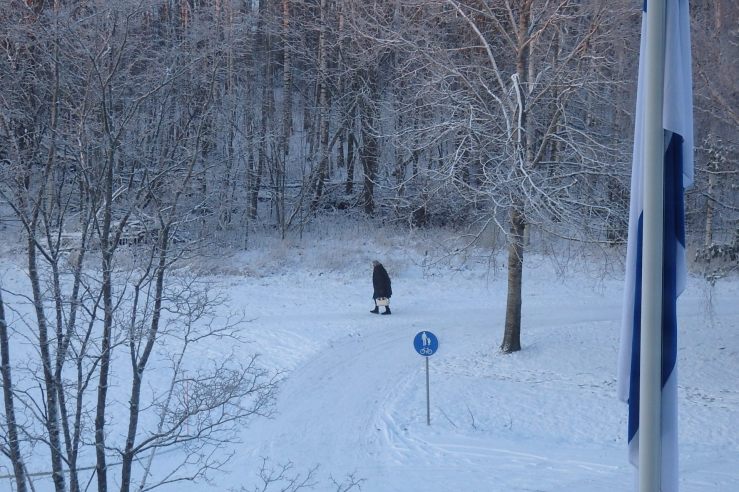
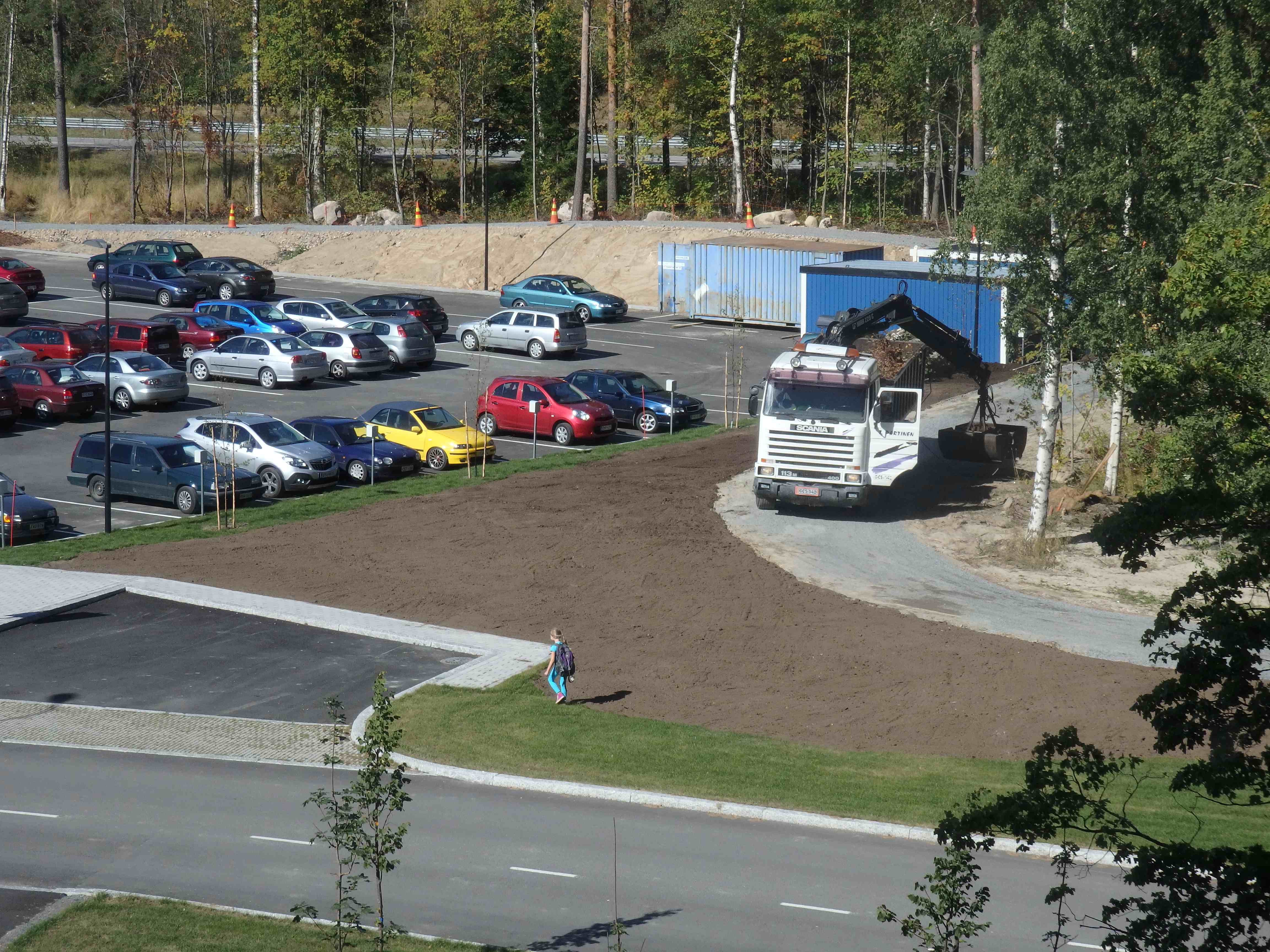
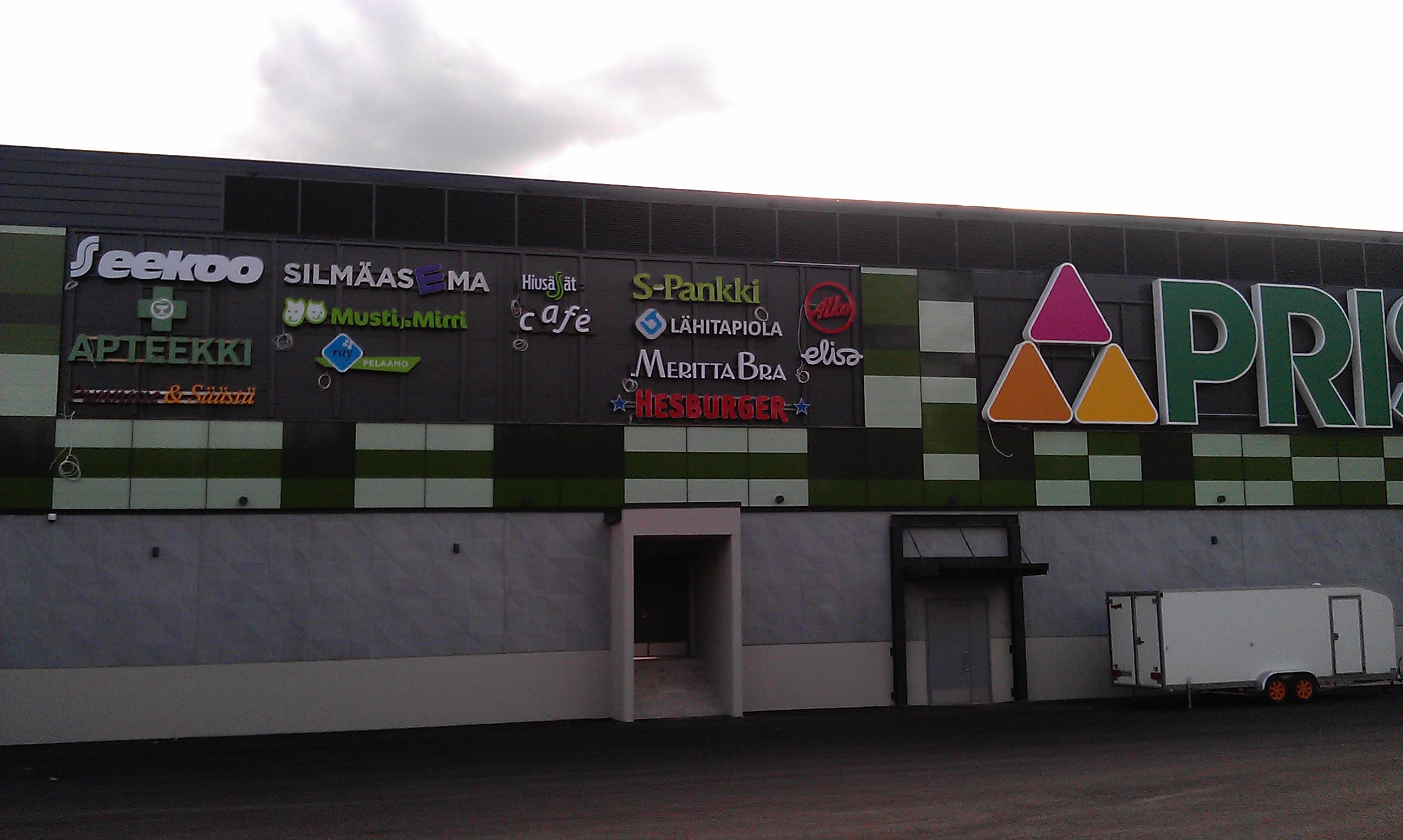
This photo, of tiny Linnalankatu in Imatra, South Karelia, will not be featured in the show at the Hermitage. One of the qualities that Finnish modernist architecture has been praised for is its sensitivity to nature and the natural environment in its interactions with the built environment. Many of the masterpieces by, say, Alvar Aalto are praised for just this extreme sensitivity.
Oddly enough, one of Aalto’s great masterpieces, the Church of the Three Crosses, is located in Vuoksenniska, Imatra’s northernmost district. It was built in the 1950s, the same decade that saw Aalto drafting a master development plan for Imatra, which was then only a kauppala (market town), not a full-fledged kaupunkki or city.
Aalto’s plan featured a polycentric conception of the burgeoning market town with ambitions of becoming a city, with Imatrankoski (long a tourist center because of its famous rapids), Mansikkala (then mostly an apple in the eyes of city planners), and Vuoksenniska, all of them at a fair but reasonable distance from each other, each serving as an equal but distinct city center around which smaller residential neighborhoods would grow, with certain functions (such as administration and culture, in Mansikkala) focused in one particular center, while other functions, such as commerce, overlapping in all three centers.
Aalto counted on Imatra growing into a mighty city with a population of one hundred thousand by the 1980s. As it was, during its heyday in the eighties, the town had something like thirty-two thousand residents, while today that number has shrunk to below twenty-eight thousand.
It is hard to know what Aalto would have made of the famous housing estate that dominates Mansikkala, consisting of two types of identical high-rise buildings (there are four of each type), but for this kind of bare-bones modernist housing to work it has to be lushly interlarded with and surrounded by trees, meadows, shrubs, and other kinds of greenery.
When you build an estate like this and you’re not Alvar Aalto you cannot afford the luxury of not knocking down trees during construction, as Aalto famously did when building the Church of the Three Crosses. (Infamously, all those beautiful trees Aalto spared were blown down during a terrible storm a couple of years later.) In any case, old photos I have seen of the area back then show that Mansikkala was mostly fields and farmhouses.
So it has taken around forty years for the estate to become the lush, homey, quiet piece of semi-paradise its builders and first residents (many of them building co-op members, many of them still alive albeit in their late seventies or eighties) hoped it would be when they planted trees, shrubs, and grass around the comfortable but rather stark new residential buildings in Imatra’s new center, Mansikkala.
You are probably wondering right about now where all that lush greenery is in the photograph, above. Well, up until two years ago, the entire foreground and right side of the view you see was occupied precisely by trees, shrubs, and a largish meadow.
But it had to give way to a new big box store, the city’s biggest, in a neighborhood that already featured three large supermarkets and a big discount store. The new city planners and fathers, however, seeing the “neighbors from the east” coming over the border in increasing numbers a few years back, decided to throw caution to wind and let the powerful S Group rip up all that greenery and install a Prisma hypermarket in its place.
The irony was that S Group already had a Prisma store literally right across the street from where the new colossus to shopping-as-our-only-salvation now stands.
To make a long story (whose other parts I will probably tell later) short, the bottom dropped out of the Russian cross-border shopping market, predictably, and now the Prisma hypermarket looks set to destroy its competitors not only in Mansikkala but in the other two central districts of the city as well, because its original purpose, to satisfy ever-increasing numbers of whimsical and wasteful Russians, has disappeared, so it has to have some other purpose, even one it might not have wanted originally. Because what city of twenty-seven thousand people needs the retail capacity of a city of one hundred thousand, as Imatra has now?
Panel 1
Wagner: “I’ve learned to speak stadi [Helsinki] slang.”
Panel 2
Wagner (in stadi): “Hey, tram driver, close the door. There’s a cold breeze in here. Do you understand?”
Tram Driver: “?!”
Panel 3
Tram Driver (in Karelian dialect): “I don’t understand. I’m from Lappeenranta.”
Wagner: “I should have guessed.”

Unknown Artist, Portrait of Alexander Stubb on a Finnish Welfare Application Form. Photographed in the painting department at Saimaa University of Applied Sciences (Saimaan AMK), Imatra, September 19, 2015, during Kaakon Taiderastit, an open-house studio and art space crawl held in South Karelia and the Kymi Valley on September 12 and September 19. Photo by Living in FIN
“In the manner of Arkady Rylov, Difficult Journey. Oil on Canvas. Pargas Local History Museum. [Vladimir Lenin] was one of the ‘living suitcases’ of Finnish smugglers. Lenin fled to Finland just before Christmas 1907 after an unsuccessful attempt to begin a revolution in Saint Petersburg. Before continuing to Sweden, he spent a couple of nights hiding in Parainen, in the Kirjala manor. He introduced himself as ‘Doktor Müller,’ a German geologist. The Pargas Local History Museum received this work for its Lenin memorial room in 1969 from the Finland-Soviet Peace and Friendship Society.” The painting is currently on view at the South Karelia Art Museum in Lappeenranta, Finland, as part of the exhibition Barefoot: 10 Lives in the Karelian Isthmus, which runs until January 2016. Photo by Comrade VZ. Quoted text, above, reproduced from the exhibition signage


Imatra ranked at the tail end of Finnish municipalities in a happiness study by newspaper Helsingin Sanomat, in 243rd place. [Neighboring] Ruokalahti, on the contrary, did fairly well, coming in as Finland’s fifty-eighth happiest municipality. [Neighboring] Rautjärvi ended up in 199th place. At the moment there are a total of 317 municipalities in Finland, sixteen of which are in the [autonomous] Åland Islands.
[…]
In Imatra, use of anti-depression medications is slightly above the national average. Nine percent of residents take anti-depressants, while the average is 8.4 percent among Finnish municipalities. Child welfare clients among minors residing in Imatra is as much as ten percent, while the average is 6.5 percent among Finnish municipalities.
Also, the number of offenses committed while drunk or under the influence of drugs is relatively high. Two people per every thousand Imatrans are charged with having committed a crime while intoxicated, whereas the average in Finland is 1.2 person per thousand residents.
[…]
—Mari Lääperi, “Imatra Did Not Fare Well in Happiness Comparison,” Uutisvuoksi, September 1, 2015
Photo and translation by Living in FIN
kuuluisassa vallankumouksen historiassaan Trotski kertoo
kun Leninillä
oli silmälasit ja tekotukka
kun Pietarissa satoi
äiti Venäjä synnytti lasta
josta oli tuleva
kun tarjoilu on loppunut
asiakkkaat hätistelty pois
tuolit nostettu pöytien päälle
ja kassa laskee rahoja
kun katsoo tätä ulkoa
ja kaikki on niin kuin tavallisesti
ja jatkuu ja on jatkunut
auto näyttää omaisuuden arvoiselta minä olen pelkkää
pimeyttä niinkuin enkeli
joka lentää omaa valoaan nopeammin
—Pentti Saarikoski, Mitä tapahtuu todella? (1962)
in his famous history of the Revolution Trotsky says
when Lenin
had glasses and a wig
when it was raining in Petersburg
Mother Russia gave birth to a child
from which the future emerged
when service is over
the customers shooed out
the chairs put on the tables
and the cashier is counting the money
when one looks at this from outside
and everything is as usual
and goes on and has been going on
the car looks like it is worth a fortune I am mere
darkness like an angel
who flies faster than its own light
—Pentti Saarikoski, What Is Really Happening? (1962)
Translation and collage by Living In FIN