Moni asia, joka olisi saatava sanotuksi,
jää salasaisuudeksi.
En tiedä, mitä tapahtui,
äkkiä vain tuli valoisaa. Oliko se pilvi?
Kauniit onnelliset kasvot,
itkuiset kun elämä säröilee,
maailman osat eivät ole kohdallaan
eivätkä ne enää kohdalleen mene.
Many things that should be said
remain a secret.
I don’t know what happened.
It just suddenly became bright. Was it a cloud?
Beautiful happy faces,
Tearful when life cracks.
The parts of the world are not in place,
Nor will they ever come together again.
—Hannu Salakka, Ennen kapaisin tähän (Otava, 1983)
Finnish really is one of the world’s easiest languages.
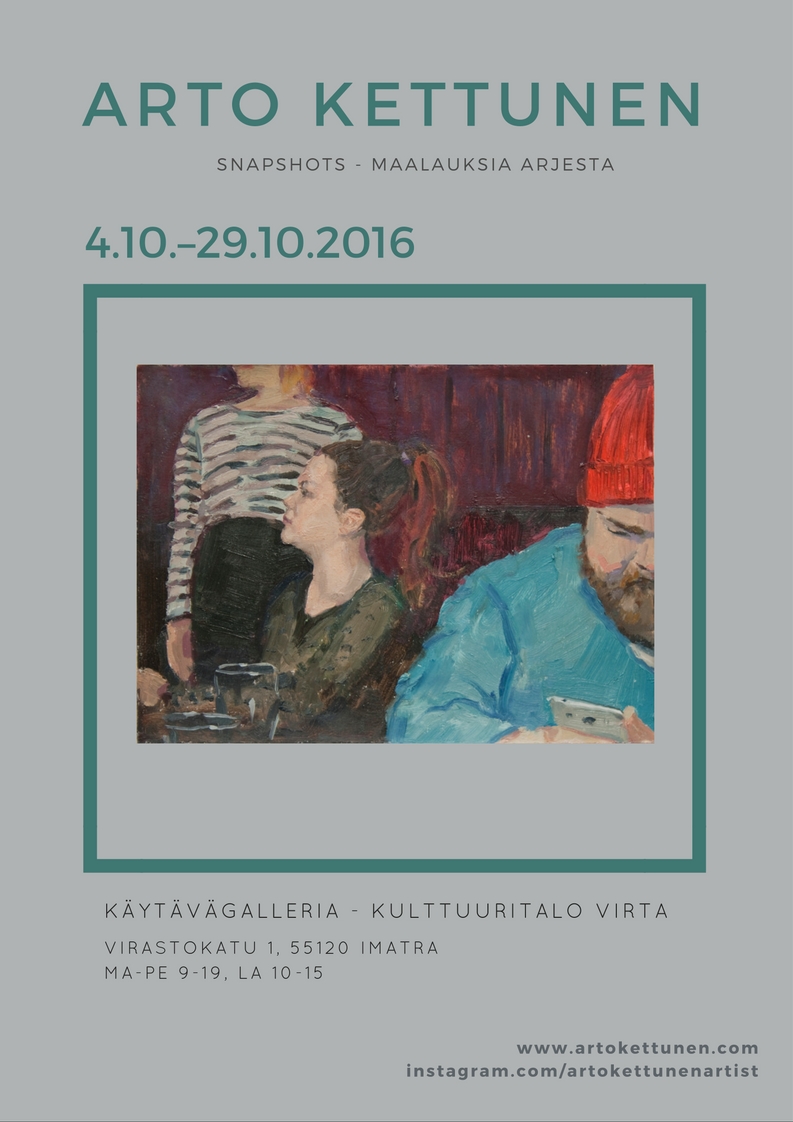
I was reminded of this again earlier today while taking in Snapshots, a fine show of recent paintings by young local artist Arto Kettunen, in the Käytävägalleria (“Corridor Gallery”) at Imatra’s cultural center, Kulttuuritalo Virta (“Stream House of Culture,” so called because it is situated alongside the once-raging Vuoksi River, dammed up on both ends during its now-short course in Finland—the rest of its length was lost to the Soviet Union during the Winter War (Talvisota) and Continuation War (Jatkosota)—to generate electricity).
Arto Kettunen, Sara ottaa selfien, 2016. Oil, 37 cm x 27 cm.
Sara ottaa selfien means, unsurprisingly, “Sara takes a selfie,” by analogy with the common expression ottaa valokuva, “(to) take a picture.”
Mr. Kettunen’s show runs until October 29. Be there or be square.
Another linguistic point of interest is that the show is entitled Maalauksia arjesta in Finnish—not “Snapshots” per se, but “Paintings from [or, about] Everyday Life.”
Arki is the nominative case of the word, which means, alternately, “weekday” or the ordinary, mundane days in life, the everyday. Given its mundaneness, you hear the word constantly in daily life—for example, in advertisements for daily specials at grocery stores.
The non-Finnish part of me (which is all of me, since I’m not Finnish) would like to wax poetic about the supreme importance of everyday life to Finns and Finnish culture (as opposed, say, to ruling the world), and how that makes Finland such a lovely, safe place to live most of the time, but I lack the words, even in English, to describe its complex simplicity.
Making Viipuri soft pretzels is tough, demanding manual labor. Photo courtesy of Pyry Sarkiola/Yle
The Recipe Won’t Be Uttered Even on the Deathbed
Is a Favorite Delicacy Threatened with Remaining a Prisoner of the Past?
Petri Kivimäki Yle
October 4, 2016
Viipuri soft pretzels [viipurinrinkeleitä] have been made in small home bakeries in the Lappeenranta region for centuries. Back in the day, they were taken to the Viipuri (Vyborg) market to be sold, among other places. The pretzels are still produced, but the customer base is thinning and the number of bakeries dwindling.
It is up and early in the Lappeenranta village of Hanhijärvi on Monday morning. At half past two, Risto Helkala arrives in the back room of a single-family house that doubles as a bakery.
“I make two batches of dough so they can get right down to baking at five-thirty.”
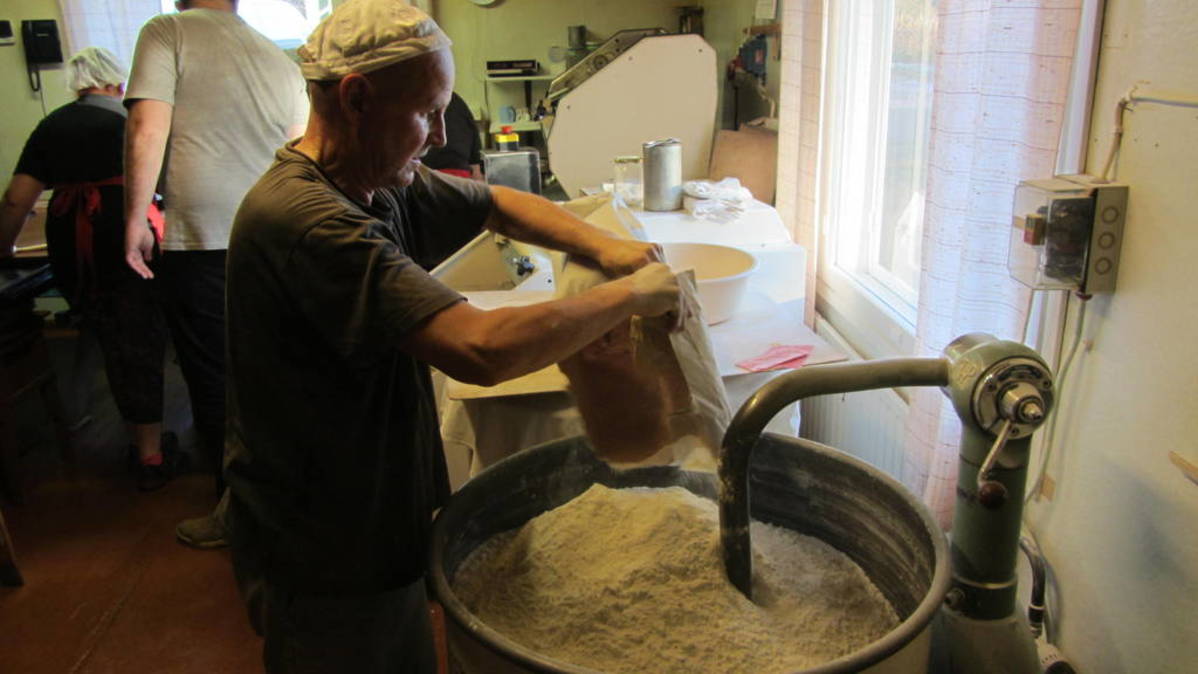
Helkala first pours sugar into the bottom of a large dough mixing bowl. Then a couple of buckets of water, cardamom, and other spices. The yeast is the size of a brick. There is a tubful of butter.
“I don’t know many liters of dough will come out, but 60 kilos of flour go in,” says Helkala.
A big mixer begins mixing the dough in the metallic dough bowl.
Risto Halkala puts 60 kg of flour into the dough. Photo courtesy of Petri Kivimäki/Yle
Centuries-Old Roots
Juho Pulli Bakery is in an ordinary looking single-family house in Hanhijärvi, in the Lappeenranta countryside. 86-year-old Ritva Helkala lives in the house. As a little girl, she would go to the markets with her father, Juho Pulli.
“I was selling pretzels on the market on Red Square in Viipuri (Vybog) when I was six. Father and mother would go somewhere and leave me to sell the pretzels.”
In the 1930s, the trips from ranged from Lappeenranta to as far away as Joensuu, Hiitola, Lahdenpoja, Värtsilä, and Suistamo. They traveled by horse or train.
“A ledger book from 1880 has been preserved which shows that 19 trays of pretzels were produced. Pretzels have been made here for a long time,” says Ritva Helkala.
Secret Recipe
Nowadays, there are a dozen pretzel bakeries in Lappeenranta and the neighboring municipality of Lemi. Each bakery’s pretzels taste different, and the recipes are secret.
“I make grandfather’s recipe, and he said he was making his grandmother’s recipe,” says Risto Helkala at the bakery.
The dough has been rising for just over an hour. It is time for the dough to be kneaded.
“Here we batten the dough down to get the air out of it.”
According to new laws, the dough’s ingredients must be listed, but how much of what is used is a carefully guarded secret.
“A Viipuri pretzel baker would not reveal the recipe even on his death bed,” says Ritva Helkala.
Dozens of pretzels awaiting buttering and bank. Photo courtesy of Pyry Sarkiola/Yle
Ingredient Shortages during the War Years
Although the Viipuri pretzel has been made for centuries, the war years of 1939-1945 and their aftermath led to a serious disruption in production.
“There were ten years when pretzels could not be baked. There were no ingredients, and there were no markets.”
Then, when the war ended, pretzels were a bit peculiar. Not all the ingredients could be obtained.
“They were made with the spices that could be spared. Then, after the wars, cardamom became available. When restrictions on the sale of sugar were removed, production took off again,” recalls Ritva Helkala.
Her son Risto has rolled out the dough. He is making a stick a meter long and thick as an arm.
“It’s like a snake. It’s called an anaconda,” Risto says with a laugh.
There are five women in the bakery besides Risto.
“Get ready. The pretzel-making is beginning,” Risto exclaims.
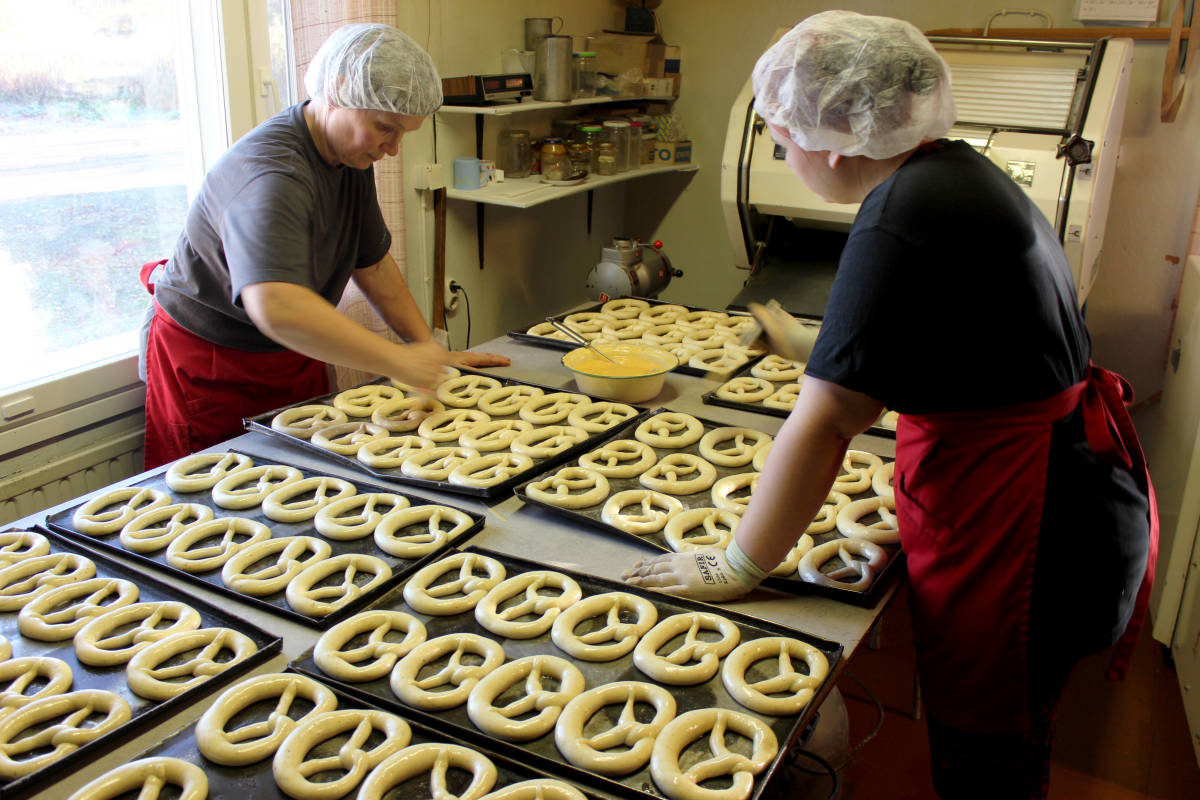
The pretzels are moistened with egg mixture. Photo courtesy of Pyry Sarkiola/Yle
Pure Craftsmanship
In an adjoining room, Risto’s mother Ritva sits in an armchair. She still drops by to check the pretzels from time to time.
“In the 1930s, fifty kilos of pretzel dough would be made totally by hand.”
Helkala’s memory is sharp as steel, and her voice is firm.
“The dough was kneaded by hand. Two women would stand next to each other and knead the dough to finger thickness first.”
After this, the surface of the dough would be rubbed with butter. Then the stick would be put in a pile, and they would began again to knead the dough into a long bar.
“I remember when my arms would be swollen below here,” recalls Ritva.
Doughs were tougher in the 1930s and 1940s than now. According to Ritva Helkala, the pretzels had to withstand long journeys. They stood quite upright in the basket.
Three Different Sizes
At the Juho Pulli Bakery, everything is ready for making pretzels. Risto Helkala is cutting the dough stick into small pieces about a hundred grams in size.
“We’re making small pretzels now. There are also large and medium-sized pretzels. The biggest ones are the most popular,” Risto explains.
Two bakers grab the familiar pieces. Hanna-Riikka Nykänen snatches a bun-sized piece of dough and kneads it into a long, thin rod.
“I have been pretzel baking for a year. I learned it fairly quickly, since I have a baker’s education.”
Nykänen takes the rod at both ends and, in three seconds, spins it into something that looks like a pretzel. She already has a new piece of dough in her hand.
Sirpa Helkala packing the pretzels. Photo courtesy of Pyry Sarkiola/Yle
Several Bakeries
There are currently a dozen Viipuri pretzel bakeries in the Lappeenranta region. The bakeries usually operate out of single-famiy houses. Pretzel production is rarely their main livelihood. The Helkala family also owns an electrical installation company.
Twenty years ago, there were twice as many Viipuri pretzel bakeries in the Lappeenranta vicinity as there are now.
“The customer base is thinning, and marketing is pretty nonexistent,” says Sanna Lento-Kemppi of Southern Finland Farm Women and Homemakers.
Lento-Kemppi has been tracking rural entrepreneurship for years, particularly in the Lappeenranta region.
“The problem is that people don’t know where and when to get Viipuri pretzels.”
Lento-Kemppi’s surmise is easily confirmed by a quick search on the Internet. None of the Viipuri pretzel bakeries have their own Internet or Facebook pages.
“People really count on the fact that pretzels have always been sold at markets and they get them at markets.”
A new generation that doesn’t go to markets has grown up in Finland. At the same time, Viipuri pretzel buyers have also become less numerous. In Lento-Kemppi’s view, Viipuri pretzels missed out on modernization in terms of both marketing and product development.
In Lappeenranta, yet another Viipuri pretzel bakery closed last year, nor do all the existing bakeries necessarily have a successor on the horizon.
One reason for the decrease in pretzel-making is that manufacturing and selling pretzels requires persistence. One must be in good physical shape to do manual labor, and selling pretzels in the winter frost or sleet is not something everyone finds enticing.
Hot Conditions
It is +36 degrees Celsius on the thermometer in the Juho Pulli Bakery. The large wood burning stove in the corner radiates heat.
Arja Laukas lifts the large baking trays onto a perch.
“When the unbaked Viipuri pretzels have raised to the right point, they are buttered or brushed with beaten egg mixture.”
Kirsi Kostiainen, standing nearby, peeks into the oven.
“The color appears when they are done.”
One more tray goes into the oven. A motor rotates the trays in the oven’s heat. When the door opens, the soft, glowing warmth pours over Kirsi’s face. In spite of the heat and bustle, the work in the bakery flows with army-like precision.
“I’ve been doing this almost three years,” says Kirsi.
Over the years, a light spot, a spot not darkened by the ovens, has been left on the old baking trays. The spot is pretzel-shaped.
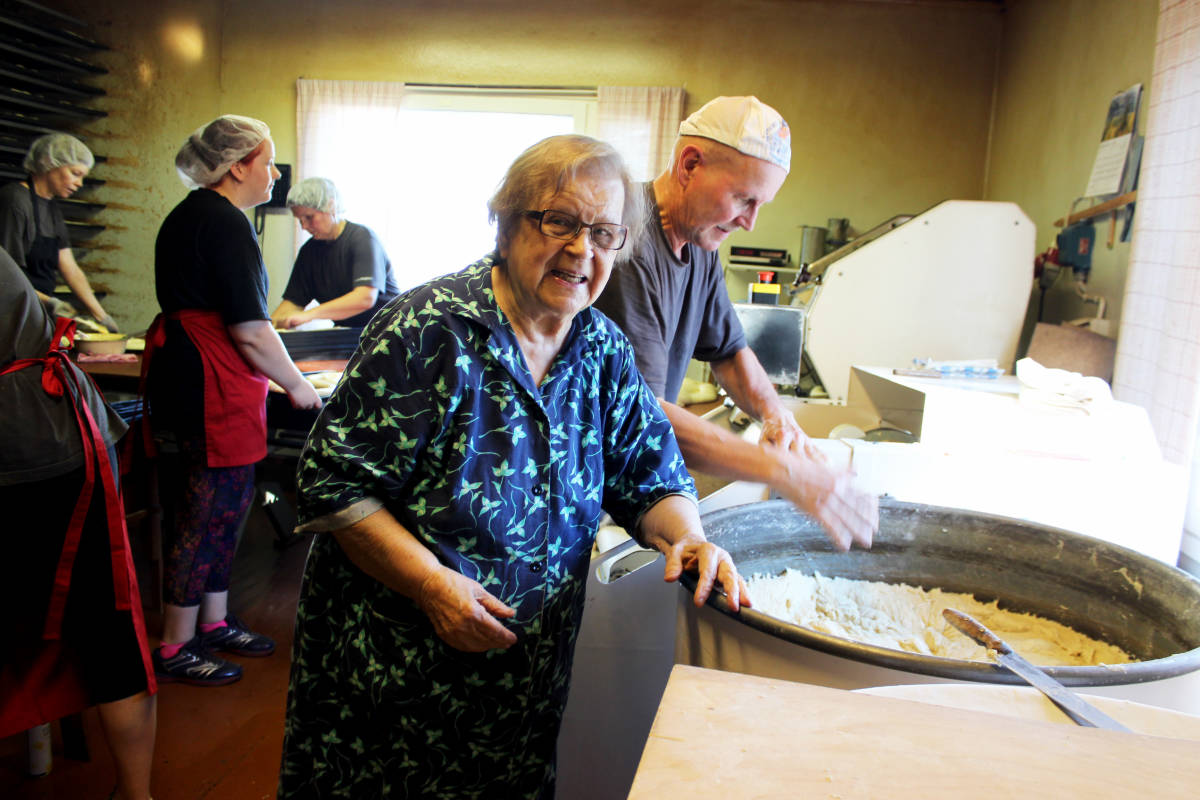
Ritva Helkala watches as her son Risto makes the dough. Photo courtesy of Pyry Sarkiola/Yle
The Craft of Baking Still Exists
Traditionally, Viipuri soft pretzel recipes and the craft of making them have been handed down from one generation to the next. In the 1930s, there were several bakeries in the village of Hanhijärvi. Their employees could go into business themselves.
“There were women at work in them who noticed that you could earn well this way,” Ritva Helkala laughs.
Her daughter-in-law, her son Risto’s wife Sirpa Helkala knows all the steps of making pretzels. She and Risto went into business in the early 2000s when the bakery changed hands generationally. Sirpa takes care of pretzel-making, as well as the company’s accounting and payroll.
“Viipuri pretzels have a good future. The business is doing well, and both young and old still like soft pretzels,” says Sirpa Helkala.
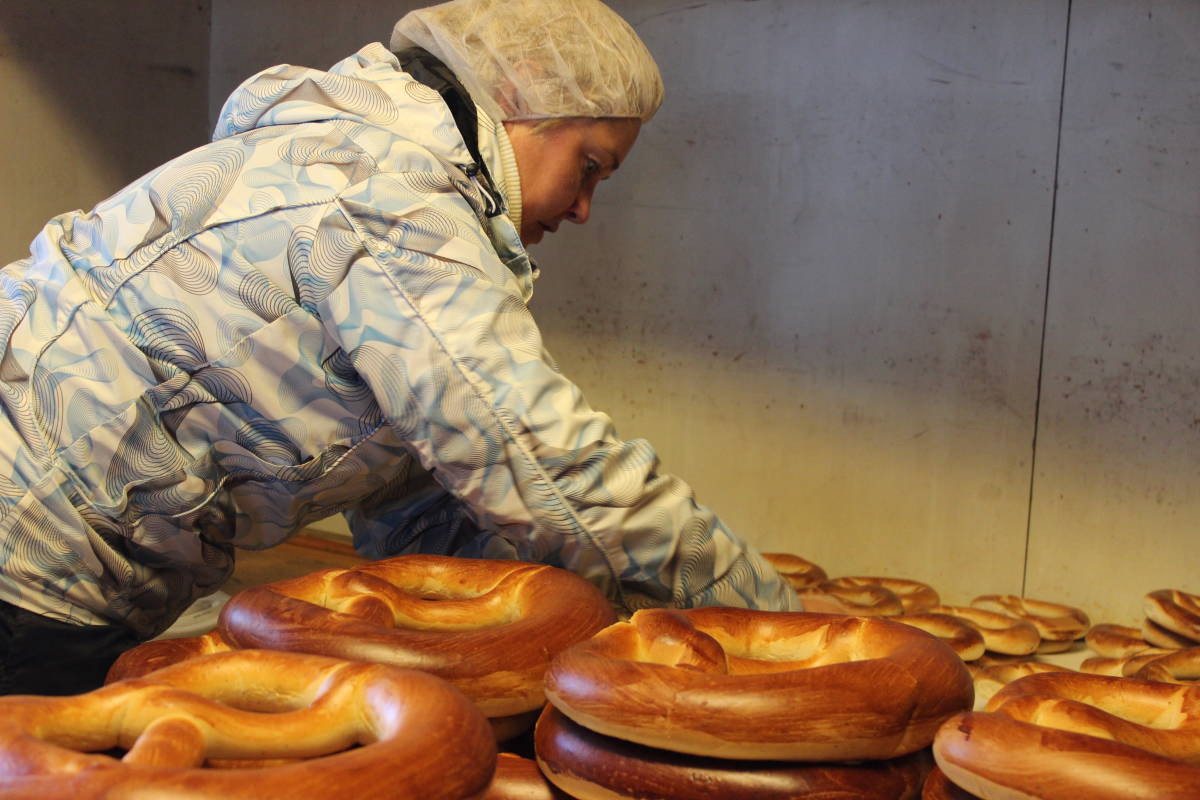
The finished pretzels are packed into bags. These are going to the market in Kuopio.
In the living room, Ritva Helkala rises from her chair and walks to the bakery side of the house. Everything seems to be alright. The new generation has taken over pretzel-making nicely.
Translated by Living in FIN. Thanks to TP for the heads-up
In real life, I’m a fairly experienced professional translator from Russian to English.
In my virtual life, I’m a hapless tyro still trying to get a handle on the orderly but utterly alien beauty of Finnish.
I’m only happy to say that, after studying the language for five or six years more or less seriously, some things are starting to feel less alien.
Then there are the dumb things you do when you’re “young”—in a language, not in life. I’ve fallen in love with an 88-year-old Finnish writer whom I’ve never met in real life and probably never will meet.
Her name is Eeva Kilpi. In Finland and other parts of the world, she is quite famous. She has even been rumored to be on the long list or shortlist (I don’t really know) for the Nobel Prize in Literature.
In English, however, she is virtually unknown. The first selection of her poems in English translation, wonderfully translated by Donald Adamson, A Landscape Blooms within Me, was published only two years ago. I could not recommend it more highly, especially because, as a bilingual edition, the book is a real boon to Finnish language learners like me.
If you’re one of the eight or nine humanoids who have been following this blog, you will have noticed I’ve been making way too much space lately for my own dubious translations of Eeva Kilpi’s poems.
So I can think of no better way of celebrating International Translation Day than pumping up the old random number generator to pick me a page number and, thus, a poem from Kilpi’s collected poems, Perhonen ylittää tien (A Butterfly Crosses the Road, WSOY, 2000), to translate for the occasion.
Chance operations took mercy on me today. They directed me to page seventy-one.
Vain kirjeen alussa me tohdimme enää
nimittää toisiamme rakkaaksi ja hyväksi.
Only at the letter’s beginning do we still dare
To call each other darling and dear.
—Eeva Kilpi, Laulu rakkaudesta ja muita runoja (WSOY, 1972)
Translated by Living in FIN. This translation is dedicated to V., my comrade in life, translating, and Finnish. It also happens to be her name day today.
Photographed by Living in FIN in the apple orchard park on the east bank of the Vuoksi River in Imatra. Imatra’s refugee reception center is less than a kilometer from this spot.
As Cholmondeley and I were rambling round town this afternoon, we came upon this excrescence.
What was the tagger who spat out this little bit of verbal vandalism trying to say? There is no such word as soumi in Finnish.
The name of the language spoken here is suomi. And the name of the country where suomi is spoken is also Suomi. Thus:
Suomessa puhutaan suomea.
“In Finland, Finnish is spoken.”
The only Soumi I could find via a quick search of the internets was the Cameroonian (?) recording artist(s) (?) who released this fabulous single, “Paracétamol,” early this year.
On the strength of this uplifting piece of patois poetry, I don’t think he or she or they deserve the putdown they got in Imatra. After all,
Imatra ei ole Afrikassa vaan Suomessa.
“Imatra is not in Africa, but in Finland.”
Africa is indeed a long ways away in more ways than one.
I scooped up the material for the first lesson in my new series, “Easy Finnish,” from the lawn as I was walking my trilingual dog Cholmondeley amid the famous tower blocks of Linnala, in ancient Imatra’s stuck-in-the-seventies Mansikkala neighorhood.
Apparently, the local smokers not only want to kill themselves. They also want to kill us with their trash, at least in the formerly picturesque Linnala.
I say “formerly,” because Linnala/Mansikkala will soon have more commercial retail space in terms of square meters per capita than any other similar neighborhood in Finland, for sure. More about that, below and later. Now we have to try and learn some Finnish.
Finnish: “Smoking is life-threatening.” Swedish: “Smoking can kill.”
The Finnish speakers are told that smoking (tupakointi) is life-threatening (hengenvaarallinen; the word is in the partitive case here). It sounds all very official and thus not to be taken too seriously.
Swedish speakers, on the contrary, are starkly told, “Smoking can kill.”
The language pulls no punches. Even a foreigner like me, whose grandfather’s native tongue was Swedish, but who has never had a single Swedish lesson in his life, gets the message.
All Finlanders, Fennophones and Swedophones alike, study both languages at school. In reality, the eastern part of the country, where Cholmondeley and I dwell part of the year, is utterly devoid of actual Swedophones.
A friend of mine once told me he tried to read a few Swedish-language novels a year to keep his school Swedish up. A couple of years ago, however, some of his neighbors launched a so-called people’s initiative to make the teaching of Swedish non-obligatory in Eastern Finnish schools. Fortunately, in March 2015, the Eduskunta, the country’s parliamentary, had the wisdom to smack down that stab at destroying the country’s identity.
Unfortunately, at the same time, they voted up an initiative that would permit kids living in the east of the country to study Russian instead of Swedish at school.
This nice-sounding but ultimately empty gesture was part and parcel of the same consumerist-driven Russophilia that, fueled by the relative prosperity of Petersburgers and Muscovites a few years ago (before Putin’s desire to become Master of the Universe and a big drop in the oil price tanked the Russian economy), caused the big towns of South Karelia, Lappeenranta and Imatra, to start reshaping themselves, often in stupid and destructive ways, to accommodate the Russian tourist-shopping boom. Now, just a few years later, the boom has almost completely dried up.
In any case, judging by what I have read in the press, none of this commercial frenzy has had any effect whatsoever on what foreign languages Finnish kids want to study, whether they live in the allegedly Russophilic east or the Russo-indifferent west. They still want to study languages that will have some utility for them as citizens of a European Union country and a globalizing world—German, French, and, above all, English.
Finnish legislators, on the contrary, apparently think the brightest dream the young people of South and North Karelia harbor for their lives is working in the tax-free checkout line at K Market, S Market or Lidl, where they can employ their high-school Russian to best effect.
Until recently, at least, you would see lots of empty Russian cigarette packs littering the yards, byways, beaches, and woods of Imatra, which is situated smack on the Russian-Finnish frontier, and is home to one of the country’s busiest border crossings.
These packs were probably not tossed on the ground by environmentally unfriendly Russian tourists and shoppers (although they would think nothing of doing just that in their own heavily polluted homeland), but by Imatrans themselves, unbelievably, especially since ten or so years ago you would have look hard to find any litter on the ground in this now-tarnished little gem of a town.
For the past several years, however, the locals have been taking advantage of the relative cheapness, in neighboring Russia, of certain vital goods like petrol, fags, and booze to dash across the border to Svetogorsk (the former Finnish town of Enso) to fill up their tanks and load up on cigarettes and hard alcohol.
But a new rule has come into effect (I forget which side instituted it) that obliges Finns to spend at least 24 hours on the Russian side of the frontier to be able to bring back three cartons of cigarettes.
That might put the kibosh on the once-routine petrol-and-cigarettes runs to Svetogorsk, but it might also ramp up the clandestine cross-border trade in some of those goods, which has been booming in parallel with legal commerce these past ten years.
In any case, the Swedophones have it right: smoking can kill.

 Moni asia, joka olisi saatava sanotuksi,







 Living in FIN